sildenafil generico viagra ricetta levitra 20 mg receta viagra acheter propecia sildenafil precio cialis sans prescription clomid prix kamagra generique kamagra 100 vendita viagra cialis venta libre aquisto levitra generische viagra viagra 50 mg farmaci impotenza viagra venta libre vardenafil generique levitra france achat de cialis levitra generico procurer du cialis vendo cialis viagra preço acheter du viagra comprar cialis em portugal comprar cialis comprar vardenafil commander cialis cialis prix kamagra te koop acheter cialis sans ordonnance generische cialis comprar sildenafil vente levitra compro levitra zithromax prix acheter kamagra oral jelly tadalafil generique viagra generique venta de levitra acheter cialis moins cher vendita levitra cialis rezeptfrei cialis 20 mg viagra controindicazioni comprar viagra pela internet vendo viagra milano pastilla levitra vente de cialis sur internet cialis bon prix sildenafil sin receta prezzi viagra levitra precio achat kamagra acheter isotretinoine viagra preis commande levitra acheter kamagra france acquisto viagra net viagra ordonnance viagra vendita italia levitra prezzo viagra versand vente de cialis compra viagra cialis vente en ligne vendo viagra comprare viagra kamagra rezeptfrei levitra prijs prozac sans ordonnance costo levitra tadalafil precio remede impuissance acquisto viagra italia cialis prezzo achat pharmacie cialis ohne rezept levitra ricetta compro sildenafil levitra sur internet impuissance sexuelle cialis en ligne sildenafil kaufen acheter viagra viagra ohne rezept viagra quanto costa levitra en pharmacie medicament viagra cialis 10 mg acquisto viagra levitra sur le net propecia generique levitra italia medicament cialis cialis en pharmacie cialis quebec acheter kamagra 100mg viagra dosaggio cialis generico cialis marche pas disfunzione erettile rimedi pilule levitra achete cialis cialis ordonnance cialis sur le net zyban generique impotenza rimedi acheter cialis en belgique achat cialis en ligne viagra pharmacie levitra generico vardenafil bestellen cialis receta levitra sans prescription acquistare cialis generique cialis cialis donne acquista viagra levitra donna viagra te koop levitra te koop viagra sans prescription levitra ohne rezept acquisto viagra in contrassegno viagra 100 mg acheter cialis sur internet viagra fur frauen achat viagra en ligne cialis prescrizione le viagra

Archive for Big Pine Key & Lower Keys

Upper Keys Author Spotlights Favorite Snorkel Sites

For award-winning writer Brad Bertelli, life is about noticing the little things — especially when he’s hovering over coral heads offshore. His book, “Snorkeling Florida: 50 Excellent Sites,” reveals many of his favorites, and the reefs of the Florida Keys (renowned as North America’s most accessible dive and snorkel destination) best represent what the water has to offer.

"Snorkeling Florida" spotlights underwater aficionado Brad Bertelli's favorite Florida Keys snorkeling spots.

"Snorkeling Florida" spotlights author and underwater aficionado Brad Bertelli's favorite Florida Keys snorkeling spots.

Brad’s favorite snorkeling sites include coral reefs, seagrass beds and shipwrecks. Luckily for aquatic enthusiasts, the Keys provide easy offshore access to each underwater environment. Water depths are typically shallow, and water temperatures range from the 70s in winter months to the 80s in summer — practically guaranteeing a safe and enjoyable trip.

If you’re a snorkeler, kicking from shore just beyond the seagrass beds will bring you to structures such as coral heads, rocks or outcroppings where you can see a variety of fish.

“Fish look for these ’condos‘ to live and dart in and out of,” Brad said.

Sightings increase, he advised, when the tide is changing or at low tide, and when there’s low wind — usually in the early morning hours before afternoon clouds build up and create surface chop.

Snorkeling sites in the Keys are shallow, allowing for maximum light (and color) exposure along the reef line. (Photo by Pat Taylor)

Snorkeling sites in the Keys are shallow, allowing for maximum light (and color) exposure along the reef line. (Photo by Pat Taylor)

Keeping a slow pace is important as well. Snorkeling is not a race, so take your time to examine the reef, soaking it all in. The ease of snorkeling is what makes it so appealing for people of all ages and experience levels.

Key Largo is brimming with fine snorkeling spots — many of them in or near John Pennekamp Coral Reef State Park. They include the north end of Molasses Reef, a beautiful and shallow strip of reef lush with schooling blue striped grunts and Florida favorites like sergeant majors, horse-eyed jacks and Bermuda chubs.

Just off Founders Park on Plantation Key is a group of coral heads between three and four feet tall. For a family with little kids, cruising down the jetty is great for spotting nurse sharks, rays, starfish and seahorses.

Off Islamorada’s Cheeca Lodge, Brad often hovers over “Cheeca Rocks,” a shallow, healthy cluster of robustly populated coral heads that aren’t heavily dived.

Shown here above water, author Brad Bertelli offers informative insights on the Keys' underwater world based on his first-hand experience.

Shown here above water, Brad Bertelli offers informative insights on the Keys' underwater world based on his first-hand experience.

Indian Key, accessible by boat or a 25-minute paddle by kayak, is home to small critters like banded shrimp, damselfish and juvenile angelfish that crowd around lime-colored brain coral heads.

In the Lower Keys, though Looe Key is legendary for its glorious finger reef seascape, Brad said his all-time favorite shore snorkel is the untouched and uncrowded beauty at Bahia Honda State Park. In shoreside waters only four feet deep, you can spot “babies” from a variety of species including starfish and conch.

“What is so remarkable about snorkeling the Keys is how much you can see offshore without having to be on a boat,” stated Brad. “You can wade in off the beach and it’s truly breathtaking.”

Comments

Tales from Chris Robinson: Buns, Buffett and Bonefish

Before Chris Robinson became a Lower Keys fishing guide, he co-owned the All-Breeds Hot Dog Pound, tended bar for some 20 years at Key West’s landmark Chart Room and Louie’s Backyard, and shared adventures with Jimmy Buffett and other notables.

A young Key West bartender in the 1970s and early '80s, Robinson met writers, actors and musicians fleeing the “real world” -- including poet Jim Harrison and then-struggling singer/songwriter Jimmy Buffett. (Photos courtesy of Chris Robinson)

As a young Key West bartender in the 1970s and early '80s, Chris met writers, actors and musicians fleeing the “real world.” (Photos courtesy of Chris Robinson)

In fact, when Chris arrived in Key West in 1972, the 24-year-old from St. Augustine, Fla., found himself in a renegade seaport town. Politicos ran the government largely from the Chart Room Bar (where Chris captured a coveted bartending job), hobbyist pot smugglers were admired as romantic outlaws, and local treasure hunters drank rum with Pulitzer Prize–winning escapees from the literary mainstream.

Tall and spare, with long hair and a luxuriant moustache, Chris displays a storyteller’s wit, easygoing attitude and lively enjoyment of the absurd. During his early Key West years, those traits served him well in an offbeat venture begun with buddy Tommy Hicks.

“We opened the world-famous All-Breeds Hot Dog Pound on Greene Street,” said Chris. “Our motto was We Relish Your Buns.”

The business didn’t last long, but old-time Key Westers still wax nostalgic about the “pound’s” juicy hot dogs nestled in soft Cuban rolls.

At that time, Key West’s ramshackle charm and end-of-the-road atmosphere made it a magnet for writers, actors and musicians fleeing the “real world.” Among them were novelist and poet Jim Harrison, “Ninety-two in the Shade” author Tom McGuane and struggling singer/songwriter Jimmy Buffett, who later memorialized the Key West lifestyle in song and earned enduring fame.

Always drawn to the water and fishing, Chris (at left holding a freshly-caught permit) eventually became a Keys fishing guide.

Chris (at left holding a freshly-caught permit) eventually became a Keys fishing guide.

“He was not a star then,” said Chris. “He used to sit with his little guitar and amp and play in the Chart Room.”

The two became friends when Buffett moved into the oceanfront apartment above Chris’s beside a bar and restaurant named Louie’s Backyard.

By 1986, Chris was tending bar at the Afterdeck at Louie’s, an open-air cocktail deck on the edge of the Atlantic, whose clientele combined local fishermen, upscale tourists and visiting celebrities. It was a position he would hold for 18 years.

Yet while he enjoyed the Keys’ partying pursuits, Chris also was drawn to life on the water. An angler since his childhood, he bought a boat shortly after arriving in Key West and learned flats fishing tips from Tom McGuane.

In action on the Florida Keys flats, Chris guides anglers to tarpon, bonefish, permit, barracuda and the occasional shark.

In action on the Florida Keys flats, Chris guides anglers to tarpon, bonefish, permit, barracuda and the occasional shark.

Eventually he got his captain’s license and began guiding. In 2004, he retired from Louie’s Backyard and began chartering full time on his 18-foot Action Craft, fishing the flats for tarpon, bonefish, permit, barracuda and the occasional shark. He called his business Big Kahuna Charters.

Unlike some of his contemporaries, Chris enjoys guiding novice anglers as much as he does seasoned pros.

Poling through the shallows, he also shares his love of the diverse and vibrant Keys environment with his clients — pointing out sea turtles, spotted eagle rays, stingrays and manatees.

“I tell people it’s an eco-tour with a chance to catch a fish,” said Chris.

It might be a long road from the bartending high life to the natural realm of the flats, but Chris Robinson has traveled it with grace — and few regrets.

Some years back, while guiding a Chicago office worker on a February fishing escape, he realized just how lucky he was.

“It was about 80 degrees, the water had three different colors and the sky was that big, high-pressure clear deep blue,” said Chris, “and he looks at me and he goes, ‘Nice office’.”

Comments

News Alert: Weather Channel Predicts Snow in the Lower Keys!

Crazy as it sounds, the Weather Channel is forecasting snow in the near-tropical Florida Keys on Christmas Day.

Weather Channel meteorologist Adam Berg (right) surprises Lower Keys resident Howard Livingston with the news that his family won the network's "Guaranteed White Christmas" contest.

Weather Channel meteorologist Adam Berg (right) surprises Lower Keys resident Howard Livingston with the news that his family won the network's "Guaranteed White Christmas" contest.

Specifically, though snow has never been recorded in the island chain, they’re forecasting it at the Lower Keys home of musician Howard Livingston — winner of the network’s nationwide “Guaranteed White Christmas” contest.

For Howard’s grand prize, The Weather Channel plans to orchestrate a massive manmade snowfall at his home overlooking the Atlantic Ocean. Meteorologist Adam Berg will be on hand to broadcast live coverage of the unprecedented “snow event” between 8 a.m. and 2 p.m. Christmas Day. It’s likely he’ll be broadcasting from the Lower Keys on Christmas Eve as well.

Michael Walker, Howard's grandson, starred in the family's video entry that earned them an unprecedented snowfall in the balmy Lower Keys.

Michael Walker, Howard's grandson, starred in the family's video entry that earned them an unprecedented snowfall in the balmy Lower Keys.

“I didn’t think we had a chance, because I didn’t think they could possibly make snow when it’s 80 degrees,” said Howard, who shares his home with his wife of two months, Cyndy, and their two dogs.

He found out differently when Adam and a Weather Channel crew flew in Dec. 13 to deliver the good news in person.

“When Adam Berg showed up, our jaws dropped because we recognized him,” he admitted. “I was flabbergasted.”

Howard was chosen from hundreds of contest entrants who submitted brief videos explaining why their families deserved a white Christmas. His 60-second piece shows the touring/recording musician and songwriter in his sunny waterfront yard, trying to make snow for his six-year-old grandson Michael Walker in a quirky blender powered by a 1952 Johnson outboard motor.

Using an offbeat blender/boat motor, Howard attempts to blend snow for his grandson Michael in the LIvingstons' winning video entry.

Using an offbeat blender/boat motor, Howard attempts to blend snow for his grandson Michael in the LIvingstons' winning video entry.

According to a Weather Channel spokesperson, on Christmas Howard’s yard will be blanketed by tons of snow created from shaved ice by a snowmaking and special effects company.

The white stuff is designed to be “packable,” making it ideal for shaping snowballs and snowmen (much to the delight of Michael, who has already figured out the accessories he needs to construct the perfect snowman).

Before learning about their surprise contest victory, the Livingstons were planning a family Christmas with Michael, Howard’s daughter and Michael’s mother Amanda Walker, her partner Tyler Hanson and their 11-month-old daughter Courtney Hanson, who live nearby.

Wearing Santa hats in anticipation of their white Christmas, the Livingston family awaits the first flakes in their sunny oceanfront yard.

Wearing Santa hats in anticipation of their white Christmas, the Livingston family awaits the first flakes in their sunny oceanfront yard.

“We generally spend Christmas at home with Michael, open gifts in the morning and cook some lobster on the grill,” said Howard.

Grinning broadly, he added, “We’re going to do the same thing this year, but with snow.”

The happy contest winner — whose infectious tropical rock tunes with his Mile Marker 24 Band include “Blame It On the Margaritas” and, coincidentally, “Local On the Eights” about The Weather Channel’s local forecast segments — also intends to fire up the offbeat blender/boat motor featured in his video entry.

On Christmas, however, Howard won’t need to employ the blender for making snow. Instead, just as he does onstage when he performs with Mile Marker 24, he’ll use it to blend margaritas for new and old friends.

Comments

These Women Care … and That’s the Naked Truth

Sixteen Florida Keys women are giving the term “naturist” a new meaning — proving their commitment to nature and community environmental efforts by posing au naturel for a 2010 fundraising calendar in some of the Keys’ most picturesque green spaces.

The "Women Sustaining the Earth" calendar showcases the Keys' natural beauty and its models' environmental commitment. (Photo by Sheelman)

The "Women Sustaining the Earth" calendar showcases the Keys' natural beauty and its models' environmental commitment. (Photo by Sheelman)

The models for the calendar, titled “Women Sustaining the Earth,” are not typical cover girls. Their chronological ages range from 44 to 78, though their grace is timeless, and the calendar combines their images with thought-provoking statements on nature and the environment.

Among the women who posed for the project are hotelier Kate Miano, proprietor of Key West’s Gardens Hotel, organic restaurant owner Charlie Wilson and former Florida Keys Mayor Shirley Freeman. Some are draped in fabric or foliage, but they all display a comfort in their own skin — plus the courage to put themselves on the line to support the Keys’ natural world.

Calendar model Rosi Ware, one of the guiding spirits behind the Key West Garden Club at West Martello Tower, was photographed here in the club's lovely secluded garden. (Photo by Carol Tedesco)

Calendar model Rosi Ware, one of the guiding spirits behind the Key West Garden Club at West Martello Tower, was photographed in the club's lovely secluded garden. (Photo by Carol Tedesco)

That natural world is one of the calendar’s enduring beauties. Locations for its mostly black-and-white art photographs include Nancy’s Secret Garden, a secluded Key West enclave nurtured by a local artist/environmentalist; the Key West Tropical Forest & Botanical Garden, home to countless rare trees and plants; the Key West Garden Club’s historic waterfront haven at a former Civil War fort; the lush and lovely grounds of the Gardens Hotel; and a remote locale called Geiger Key that was named to honor a friend of John James Audubon.

The calendar was the brainchild of Erika Biddle, host of the Key West radio show “The ECOcentric View,” who poses with recycling groundbreaker Lucy Carleton on one of its pages. She drew inspiration from a statement, credited to California Governor Arnold Schwarzenegger, that the environmental movement needed to get sexier to garner more participation.

Calendar creator Erika Biddle (left) is pictured in its pages with fellow environmental activist Lucy Carleton. (Photo by Richard Watherwax)

Calendar creator Erika Biddle (left) is pictured in its pages with fellow environmental activist Lucy Carleton. (Photo by Richard Watherwax)

For Erika, the calendar’s elegant sensuality was a means to an end: raising awareness and funds for earth-friendly Keys initiatives. The first printing of 500 calendars, which sold out almost instantly, benefited the local Green Living & Energy Education community garden effort. The second printing benefits the Mana Project, a nonprofit organization striving to sustain Nancy’s Secret Garden.

“The whole calendar is a collaboration of people who are working for a cause,” said Erika. “I’m just trying to connect the green dots.”

Like Erika and the women who posed for the calendar, the photographers who shot them — Carol Tedesco, Richard Watherwax, Lynne Bentley-Kemp and Sheelman — donated their time, energy and passion.

“The women featured in this calendar are each outstanding advocates for planet earth,” said Carol Tedesco, whose goal was to communicate their unique spirit in her photographs.

Find out more about the 2010 “Women Sustaining the Earth” calendar at www.keywestcalendargirls.com — and order one to support Mother Nature and her valiant “daughters” in the Florida Keys.

Comments

Keys Captains Score Impressive Wahoo Catches

What happens when several Florida Keys captains get together for a busman’s holiday angling trip?

Anglers on Captain Jim Sharpe's Sea Boots display some of the nine wahoo the contingent caught Dec. 8 in about 3.5 hours of fishing off the Lower Florida Keys. (Photo by Jose Hernandez)

Anglers on Captain Jim Sharpe's Sea Boots display some of the nine wahoo the contingent caught Dec. 8 in about 3.5 hours of fishing off the Lower Florida Keys. (Photo by Jose Hernandez)

They catch fish.

Tuesday, captains Mike Weinhofer and Rob Harris fished on Captain Jim Sharpe’s Sea Boots along with several of Sharpe’s neighbors, including Jose Hernandez, Al Burns, John Crockett and Albert Medina.

In about 3.5 hours of fishing, the contingent caught nine wahoo ranging from 22 to 65 pounds.

Fishing in about 125 feet of water off the Lower Keys, Sea Boots’ anglers high-speed trolled Williamson black and red Diamond and Rapala Mag 30 artificial lures.

“We hit ‘em sometimes six at a time,” said Sharpe. “We had a total of 18 fish to the boat, but we lost so many, because they were so big and they were all coming in at the same time.

“It was just insane,” Sharpe said of the successful outing.

Comments

Lessons in the Captains’ Classroom

I know a lot about fish. I know hogfish is the best tasting fish in the entire universe, particularly when cooked with olive oil, capers and a squeeze of lime. I know dolphin (the fish, not the mammal) should be broiled with garlic, herbs, butter and maybe a dollop of pesto added at the last minute. And I know that, once you’ve tasted tuna salad made with fresh Keys tuna, you’ll never touch the canned stuff again.

Knowing how to "cook the catch" is a skill ... but it leaves you dependent on those whose skills center on boating the catch.

Knowing how to "cook the catch" is a valuable skill ... but it leaves you dependent on those whose skills center on catching something for you to cook.

What I don’t know about fish is how to catch them. Fortunately, the Florida Keys are home to a breed of experts who can teach even a novice like me — as this essay by guest blogger Bob Serata, a local journalist and angler, attests.

*****

Sometimes being around one of the experienced charter captains or backcountry guides of the Florida Keys can be spooky.

Twenty-five miles from shore, seemingly in the middle of nowhere, the captain will call from the bridge, “Get those lines in.” Before long, a dolphin leaps or a wahoo starts its high-speed run.

Deep in the backcountry, on a shallow flat, the guide says, “Relax, the bones won’t be here for another 10 or 15 minutes.” Ten or 15 minutes later, three schools of bonefish cruise by.

Captain Sandy Moret, shown here with a bonefish, is an unparalleled angling expert who teaches eagerly-anticipated classes in the Upper Keys.

Captain Sandy Moret, shown here with a bonefish, is an unparalleled angling expert who teaches eagerly-anticipated classes in the Upper Keys.

After shaking their heads in wonder, wise anglers realize that much can be learned from the offshore captains and backcountry guides of the Keys.

A primary subject of discussion is fish behavior — and the lessons come in one- or two-sentence factoids.

For example, dolphin congregate under schools of bait fish. Bait fish seek cover, so they school up under floating weed or debris. The bigger dolphin will be below the smaller “schoolies” near the surface.

Troll fast for tuna — faster for big tuna. Drop down for wahoo and kingfish (king mackerel).

Lower Keys flats guide Chris Robinson treats anglers to a day of fishing, easygoing instruction and world-class stories.

Lower Keys flats guide Chris Robinson treats his anglers to a fishing experience, easygoing instruction and world-class stories.

Cast in front of the bonefish and be very, very quiet about it. Bow to a tarpon. Hang on for dear life when a permit runs.

Work the bottom for speckled trout. Or, work the surface for speckled trout. Sometimes the information seems contradictory, but that’s just because conditions change.

The captain’s job is to give anglers shots at catching fish. But the teaching goes on all day, even when the captain isn’t thinking about teaching.

Conversations during rides to fishing sites are good times to get questions answered. At the site, a “what’s that?” or “why stop here?” elicit an answer that encapsulates years of hard-learned experience.

Some backcountry guides specialize in teaching casting technique, especially with beginning fly anglers. But it’s important for the angler and guide to agree on the day’s objective.

Top tournament captains win tournaments because (a) they know where to find fish, (b) they work very hard, and (c) their anglers know how to cast. So novices or anglers who fish just a few times per year might be better served by finding a guide who welcomes the inexperienced caster.

Rick Berry, left, and mate K.J. Zeher show off a beautiful bull dolphin Berry caught while fishing on the Catch 22 off Islamorada. (Photo by Andy Newman/Florida Keys News Bureau)

Rick Berry, left, and mate K.J. Zeher show off a beautiful bull dolphin Rick caught while fishing on the Catch 22 off Islamorada. (Photo by Andy Newman/Florida Keys News Bureau)

Still, for Keys offshore captains and backcountry guides, teaching — or better, “coaching” — is an almost unconscious act.

Set the hook as hard as you can. Be gentle. Reel now. Reel as fast as you can. Slow down. Keep the rod tip up. Lean to your side. Let the fish run. Wait. Hurry. Cup it.

Advanced anglers will find support in their captains’ calls. The novice or vacation angler will find comfort in a steady stream of advice.

The problem for the angler is trying to remember all the information that’s been imparted.

Or worse, hearing that most feared of all comments on casting — “No, your other left.”

****

With such skilled instruction available, maybe someday soon I’ll catch the catch I cook. But meantime … you’ll find me in the kitchen, seasoning a fishing friend’s dolphin with garlic and herbs.

Comments

The Road Home

The southernmost stretch of U.S. Highway 1, running some 110 miles from mainland Florida throughout the Keys to Key West, has earned many names over the years. It’s been called the Overseas Highway. The Highway That Goes to Sea. And on October 16 it earned the right to be called an All-American Road, the highest national designation a roadway can receive.

The Florida Keys' Overseas Highway is now an All-American Road ... the only one to earn the top national designation in Florida and one of just 31 in the entire U.S..

The Florida Keys' landmark Overseas Highway is now an All-American Road ... the only roadway to earn the top national designation in Florida and one of just 31 in the entire U.S..

But for those of us who love the Keys, whether as residents or regular visitors, the highway has a simpler and more elemental designation: it’s the road home.

Heading south from mainland Florida, the highway leads into a world of seemingly endless water and sky. On the left, the Atlantic Ocean unrolls to a blue horizon; on the right lies Florida Bay and, further south, the Gulf of Mexico.

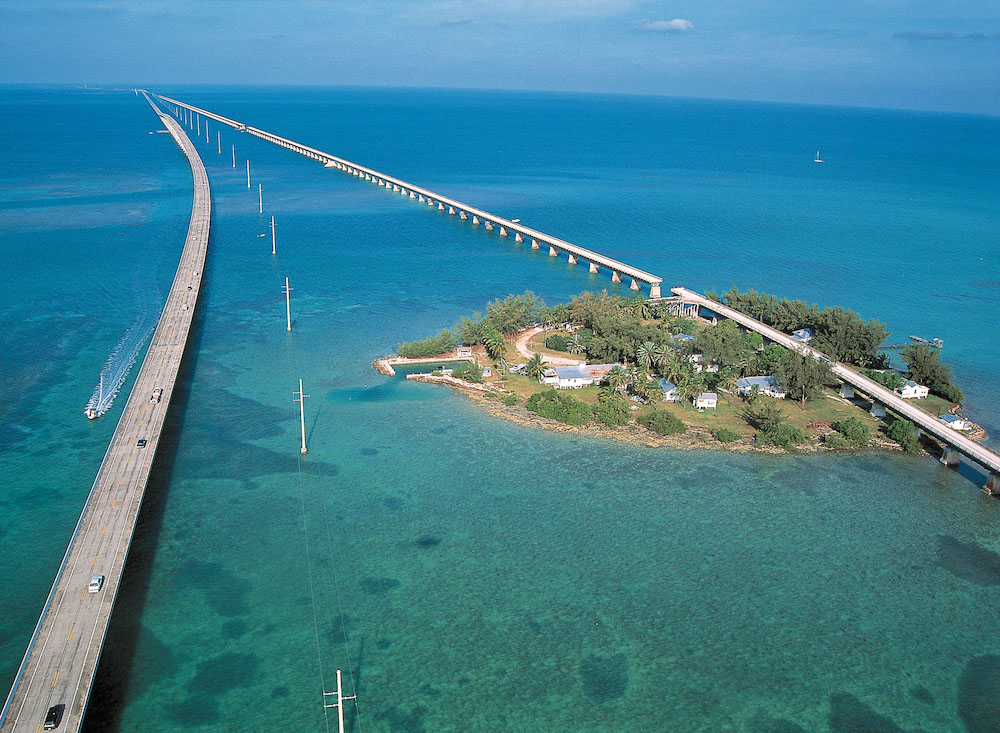
From the mainland to Key West, an astonishing 42 bridges leapfrog between islands. One of them, the Seven Mile Bridge at Marathon, stretches 6.79 miles across open water — and was once nicknamed “the eighth wonder of the world.”

The new Jewfish Creek Bridge is the first Overseas Highway span southbound drivers cross after leaving mainland Florida. (Photo by Andy Newman/Florida Keys News Bureau)

The new Jewfish Creek Bridge is the first of 42 Overseas Highway spans that southbound drivers cross on their way to the end of the road. (Photo by Andy Newman/Florida Keys News Bureau)

Yet the Seven Mile Bridge wasn’t always a highway bridge, and the Overseas Highway wasn’t always a road. It began as a railroad, the brainchild of millionaire Henry Flagler, who envisioned a train route connecting all the Florida Keys and mainland Florida. Flagler inspired an army of men to spend seven years constructing the railroad’s bridges and land-based tracks, and in 1912 the first train pulled into Key West.

After only two-plus decades of carrying freight and wealthy vacationers, much of the railroad was badly damaged in a 1935 hurricane. Three years later the Overseas Highway debuted, built on a foundation that incorporated some of the original railway spans.

In 1982, 37 original bridges including the Seven Mile Bridge were replaced with wider spans (eagerly welcomed by those of us familiar with the scarily narrow old bridges). About a third of the original bridges were removed during the project, but three of those remaining — the Long Key, Bahia Honda and Seven Mile bridges — are on the National Register of Historic Places.

This lucky couple (and their trusty flamingo "mascot" travel the 18-Mile Stretch between mainland Florida and Key Largo, just before embarking on the Overseas Highway's one-of-a-kind driving adventure. (Photo by Andy Newman/Florida Keys News Bureau)

This lucky couple (and their trusty flamingo "mascot") travel the 18-Mile Stretch between mainland Florida and Key Largo, just before embarking on the Overseas Highway's one-of-a-kind driving adventure. (Photo by Andy Newman/Florida Keys News Bureau)

Traveling down the Overseas Highway, drivers can see many of the old bridges running alongside the newer ones. And all of us who travel the road regularly have our favorite stretches and sights — talisman vistas that offer a welcome foretaste of home on the southward drive.

For example, when I reach Islamorada in the Upper Keys, I can’t help smiling as I pass a particularly beautiful cluster of contemporary oceanfront homes. Spotting the pocket-sized island of Pigeon Key, nestled beneath the Old Seven Mile Bridge, inspires daydreams about living in one of its tiny restored cottages.

Farther along the Old Seven Mile Bridge, defying natural logic, five scraggly bushes sprouted on the weather-beaten pavement years ago and somehow have managed to survive. For me, they’ve become leafy mascots. Every time I cross the newer bridge, I glance anxiously over at each bush to make sure it’s still hanging on.

The historic Old Seven Mile Bridge, at right of the newer bridge, cuts through tiny Pigeon Key and is home to five unlikely but beloved bushes.  Photo by Andy Newman/Florida Keys News Bureau

The historic Old Seven Mile Bridge, at right of the newer bridge, cuts through tiny Pigeon Key and is home to five unlikely but beloved bushes. Photo by Andy Newman/Florida Keys News Bureau

Just before Big Pine lies one of the highway’s prime vistas. At Bahia Honda State Park, a portion of the old Bahia Honda Bridge arches up against the sky, a stark and throat-catchingly beautiful reminder of the Keys’ past glories.

To earn All-American Road status under the National Scenic Byways program, a road must have nationally significant archeological, cultural, historic, natural, recreational and/or scenic qualities — and must possess features that don’t exist anywhere else, making it a visitor destination in itself.

The Overseas Highway certainly fits the bill. It’s the first and only Florida road to achieve All-American status, and it joins just 30 other All-American Roads in the entire U.S. So the designation is prestigious indeed.

But no matter how impressive the honor, it can’t eclipse the status the Overseas Highway already possesses in the hearts of Keys residents and those who wish they were. It’s our highway, our connection to each other and the outside world — and always, our road home.

Comments

No Name — But Ramshackle Charm and Great Pizza

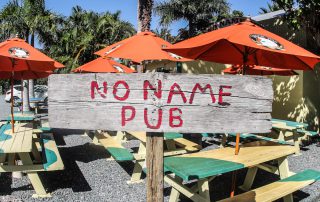
It’s called the No Name Pub, and it bills itself as the oldest pub in Florida. It might also be the hardest to find — the quirky eatery lies off U.S. Highway 1 in the Lower Florida Keys, down a winding road and over a humpbacked bridge in an individualistic settlement known as No Name Key.

You have to venture off the proverbial beaten path to find the No Name Pub, but the experience is well worth it. (Photo courtesy of the No Name Pub)

You have to venture off the proverbial beaten path to find the No Name Pub, but the experience is well worth it. (Photo courtesy of the No Name Pub)

This out-of-the-way location doesn’t keep people from discovering the local landmark — or falling in love with its historic Florida Keys charm, world-class pizza and ramshackle décor that includes interior walls papered with dollar bills.
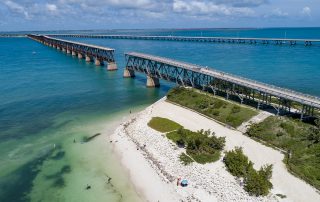
What is now the pub first opened as a general store and bait and tackle shop in 1931. In 1936, the owners began serving food; in the late 1930s they opened a brothel in an upstairs storage room.

The restaurant proved more popular than the brothel (no doubt a surprise to certain ladies eager to earn extra money!). The latter faded away, while the pub started attracting an ever-larger following.

Serious enjoyment and ramshackle decor characterize the quirky No Name Pub. (Photo courtesy of the No Name Pub)

Serious enjoyment and ramshackle decor characterize the quirky No Name Pub. (Photo courtesy of the No Name Pub)

Amenities in subsequent years included a honky-tonk atmosphere and amusements ranging from pool to less savory games of chance — some reputedly run by the local sheriff.

The pub’s famous pizza was born in 1960, prepared according to a recipe imported by two Italian cooks. It proved to be such an enduring draw that today it’s modestly promoted as “the best pizza in the known universe.”

You can choose traditional varieties or gourmet delights like a Keys shrimp pizza (a must-have treat — the combination of bubbly, slightly salty cheese and the Keys’ own sweet pink shrimp is impossible to resist).

The pub's individualistic character is exemplified by its funky casual signage. (Photo courtesy of the No Name Pub)

The pub's individualistic character is exemplified by its funky casual signs -- like the ones pictured here. (Photo courtesy of the No Name Pub)

As the pub’s nearly 70 years of popularity prove, when great food and laidback Keys flavor come together, “no name” is no barrier to success.

The place itself may be hard to find, but its website is easy. Visit www.nonamepub.com for a glimpse of the landmark’s offbeat character, historic photos, menu highlights and a more-or-less exact address (actually, you find it by turning off U.S. Highway 1 at mile marker 30.5 bayside and then following the winding road … but resign yourself to the inevitability of getting lost at least once).

AND WHILE YOU’RE LOST … EXPLORE THESE!

Big-eyed and shy, Key deer can be spotted throughout the Lower Keys widlife refuge created to protect them. (Photo courtesy of Andy Newman, Florida Keys News Bureau)

Big-eyed and shy, Key deer can be spotted throughout the Lower Keys widlife refuge created to protect them. (Photo courtesy of Andy Newman, Florida Keys News Bureau)

NATIONAL KEY DEER REFUGE, down Key Deer Boulevard off U.S. 1 at mile marker 30.5 bayside. At first, you might wonder what all the fuss is about. Then you see one — a big-eyed Key deer, no taller than a good-sized Doberman, standing at the roadside in an instant of arrested motion before it scampers away — and you’re hooked on the tiny critters. The best times to spot them are early morning and dusk, and they wander freely in the refuge. The refuge has an informative visitors’ center located in Big Pine Key’s Winn Dixie Shopping Center.

THE BLUE HOLE, within the Key Deer Refuge down Key Deer Boulevard off U.S. 1 at mile marker 30.5 bayside. This was originally an old rock quarry used in the construction of the Overseas Railroad that connected the Keys to mainland Florida (and to each other) in the early 1900s. Today it’s a freshwater habitat for alligators and wading birds. Spend a few minutes at this secluded oasis, before or after your pizza, and you’ll swear you’ve been transported back in time to the Keys’ early days.

Comments

Kayak the Unspoiled Keys Backcountry

After trying conch fritters and conch salad, browsing through some individualistic boutiques and galleries, quaffing piña coladas at sunset and enjoying a reef snorkeling or fishing excursion, you might figure you’ve sampled the best the Florida Keys can offer.

Paddle a kayak through the backcountry waters of the Florida Keys, and you'll see one of the world's most diverse marine life ecosystems. (Photo by Bob Krist/Florida Keys News Bureau)

Paddle a kayak through the backcountry waters of the Florida Keys, and you'll see one of the world's most diverse marine life ecosystems. (Photo by Bob Krist/Florida Keys News Bureau)

Guess what? You’d be wrong.

There’s another side of the Keys — a quiet world away from civilization, ruled by the natural ebb and flow of the ocean — that many visitors never see. It’s called the backcountry, and it’s home to one of the most diverse assortments of marine life in the world.

This shallow backwater region of flats and mangrove islands lies mostly along the north side of the Overseas Highway. Not easily accessible to boat traffic, the backcountry is largely untraveled, unspoiled, and teeming with plant and animal life.

The best way to explore this remarkable world is by sea kayak. The quiet, shallow-draft kayaks — beautifully stable and requiring no special skills, strength, or experience to paddle — mean virtually anyone can venture into the backcountry waters.

Unless you’re a kayaking veteran, the most enjoyable way to explore Keys waters is a guided excursion -– and you can book them throughout Keys. (Photo by Andy Newman/Florida Keys News Bureau)

Unless you’re a kayaking veteran, the most enjoyable way to explore Keys waters is a guided excursion -– and you can book them throughout Keys. (Photo by Andy Newman/Florida Keys News Bureau)

Both guided tours and kayak rentals are available throughout the Keys, but a guided tour is usually the way to go. Most guides are eager to share their knowledge about the region’s environment, so a tour can become a fascinating mixture of field trip, natural history lesson and just plain fun.

The Keys’ shallow-water backcountry environment ranges from mangrove communities to turtle grass flats to sponge flats. Mangrove islands are composed of tangled stands of mangroves, their aerial roots forming tunnels and fantastic twisted shapes.

Wildlife and rare birds abound; you might spot roseate spoonbills, osprey, great white herons, and maybe even bald eagles. Gazing over the side of your craft, you’ll discover the rich biodiversity within the mangrove root systems (the roots are actually a nursery for young grouper, lobster, barracuda and other species).

One of the delights of a kayak excursion is the chance to encounter a fascinating variety of exotic birds and marine life.

One of the delights of a kayak excursion is the chance to encounter a fascinating variety of exotic birds and marine life.

Turtle grass areas too are a unique part of the backcountry. Turtle grass looks a lot like lawn grass — but anyone who pulls up a flat green blade will see snails, tiny aquatic animals, scurrying juvenile fish, and other inhabitants of this busy ecosystem.

Also a part of the backcountry are the sponge flats — the rocky sea-bottom home to bright-colored sponges and soft corals. These include the mustard-toned golf ball coral whose domed shape and golf-ball-like dimples inspired its surprising name.

The grass flats and sponge flats can also support small lobster, young reef fish, turtles, stingrays, and big predators like shark and barracuda. If you’re lucky, you might even spot a graceful rolling tarpon.

Kayak trips are designed for novices as well as experienced paddlers; children are often welcome (it’s a good idea to check with the operator beforehand) and many people with physical challenges can enjoy the adventure with ease.

The Keys' waters are protected within the Florida Keys Marine Sanctuary, offering an unspoiled region for tranquil exploration. (Photo provided by Florida Keys News Bureau)

The Keys' waters are protected within the Florida Keys Marine Sanctuary, offering an unspoiled region for tranquil exploration. (Photo provided by Florida Keys News Bureau)

Guided backcountry tours last from about two hours to a full day or even longer. You’ll want to bring sunblock, a hat or cap, bathing suit and towels, sunglasses and a waterproof camera to capture your experiences. Many excursions include snorkeling, and snorkel gear may or may not be provided, so it’s wise to ask when making reservations.

If you love the outdoors and want to venture beyond the normal tourist realm, there’s no better way to discover the Florida Keys — the real, unspoiled Florida Keys — than on a backcountry kayak adventure. To find one that meets your needs, check out the listings at www.fla-keys.com/ecotourism/index.cfm.

Comments

’Tis the Season for Sensational Crustaceans

Would somebody please go melt some butter?

Foodies agree that virtually nothing beats the sweet, tender meat of a Florida Keys lobster.

Foodies agree that virtually nothing beats the sweet meat of a Florida Keys lobster.

Actually, somebody should go melt A LOT of butter. And don’t even think about skimming the white salty froth off the top when the butter reaches the perfect bubbly heat — that’s the best part.

It might sound crazy to people who don’t live in the Keys, but melting butter has become a seasonal hobby in these parts. Early in August each year, island foodies start stocking up on familiar yellow cartons of Land O’Lakes.

Why? Because early August marks the start of the Florida Keys’ annual commercial lobster season, and purists know those sensational crustaceans taste best when each bite is bathed in butter.

Florida Keys lobsters are quite different than their northern cousins. For one thing, they don’t have claws (also called by the unappetizing name of “grapnels”). Instead, they’re known as spiny lobsters — and their meat has a slightly chewy sweetness that Maine lobsters can’t hope to emulate.

In Keys households and restaurants from Key Largo to Key West, the most popular way to serve lobster is steamed, boiled or grilled with the aforementioned melted butter. Traditional trimmings include corn on the cob and boiled potatoes or potato salad.

Lobster purists love their crustaceans grilled and served with melted butter.

Lobster purists love their crustaceans grilled and served with melted butter.

Some Keys chefs prefer to prepare lobster split and grilled or stuffed and broiled, while others blend lobster meat with exotic sauces incorporating tropical fruits such as mango. It’s possible to start the day with a luscious Lobster Benedict at a handful of creative local eateries — and few people can resist the sensational Lobster Reuben at Keys Fisheries in Marathon.

If you’re lucky enough to have obtained your own stash of Florida Keys lobsters and want to experiment a little, try the following easy-to-prepare treats.

LOBSTER DEVILED EGGS: Hard-boil six eggs, let them cool and cut them in half lengthwise. Finely dice the steamed meat from one Keys lobster. Mix it with the egg yolks, mayonnaise to taste, and a pinch each of powdered mustard and paprika. Stuff the mixture into the egg whites and serve as hors d’oeuvres (you should have some lobster-and-yolk mixture left over to spread on crackers — yum!).  

LOBSTER CHEESE TOAST: Cut a 6-inch wedge of fresh Cuban or Italian bread and cut the wedge in half lengthwise. Toast both halves. Meanwhile, cut the steamed meat from one Keys lobster into chunks. Spread the toasted bread with mayonnaise and Dijon mustard. Top it with lobster chunks and shredded Vermont cheddar cheese, and broil briefly until the cheese is slightly bubbly. This serves one or two for lunch, depending on appetite.

Savvy chefs wear clothes and aprons when preparing lobster.

Savvy chefs wear clothes and aprons when preparing lobster.

LOBSTER CAPRESE SALAD: Slice two large tomatoes into four or five slices each and arrange them on two plates. Top the slices with crumbled feta cheese, the chopped meat from a large steamed Keys lobster, and chopped fresh basil leaves. Drizzle each salad with olive oil and squeeze lemon juice over it to taste. This serves two for lunch (or, if you use two lobsters instead of one, it can serve two for a warm-weather dinner).

While Florida lobsters aren’t typically accompanied by buns, buns were surprisingly visible during an event staged a few years back to celebrate the beginning of the Keys’ lobster season.

The Naked Chefs Lobsterfest featured live music, an open-air setting overlooking the Atlantic Ocean, and lobster with all the trimmings, prepped and served by male and female chefs who were indeed naked. Most attendees enjoyed the offbeat feast — but nearly everyone agreed that it illustrated an excellent reason to be glad Keys lobsters have no claws!

Comments

google

couk