Keys Events

Treasure Island: 25 Years Later

Since Key West’s earliest days, its atmosphere has encouraged rugged individualism — but few individuals stand out more than legendary shipwreck salvor Mel Fisher.

Adventurer Mel Fisher, discoverer of the shipwrecked Spanish galleon Atocha, proved that the American dream is thriving -- at least in the Keys. (Photo provided by Mel Fisher's Treasures)

Adventurer Mel Fisher, shown here with some of his glittering discoveries, proved that the American dream is thriving -- at least in the Keys. (Photo provided by Mel Fisher's Treasures)

Mel, a former California chicken farmer, appeared in the Keys in 1968 and shortly afterward settled in Key West. His luggage consisted of one big dream — that of finding the sunken treasure galleon Nuestra Señora de Atocha, shipwrecked in a 1622 hurricane somewhere in Keys waters.

The Atocha’s cargo, according to its manifest, included a quarter of a million silver pieces of eight, some 30 tons of silver bars, and other riches destined for the coffers of Spain. Clearly, it was a worthy prize for any man.

Some people never really fit into Key West’s offbeat lifestyle, but others — like Mel — fit in immediately. With his drawling speech and seemingly limitless capacity for rum and Coke, he became a familiar figure on the island.

During the long years of searching for the shipwrecked galleon, there was little money to support Mel and his crew — which included his wife Deo and, eventually, children Dirk, Taffi, Kim and Kane. Still, enough treasure trickled in to keep their enthusiasm alive.

Mel and Deo Fisher were early SCUBA pioneers before they became shipwreck seekers. (Photo provided by Mel Fisher's Treasures)

Mel and Deo Fisher were early SCUBA pioneers before they became shipwreck seekers. (Photo provided by Mel Fisher's Treasures)

After all, Mel reasoned, almost any day could herald the discovery of the Atocha’s main body of riches. “Today’s the day,” his well-known phrase of encouragement to his divers, began to appear on T-shirts all over Key West.

At long last, in July of 1985, “the day” arrived.

On July 18, Mel’s son Kane, then captain of the salvage boat Dauntless, discovered a 60-pound ballast stone, barrel hoops, copper ingots, and almost 1,000 silver coins in a deep-water area called Hawks Channel.

Two days later, on July 20, divers Andy Matroci and Greg Wareham dove down to investigate a promising area of the seabed. Facing them was a reef of what looked like stones. The duo went back up for a metal detector and dove down again. The metal detector went wild: it was a reef of silver bars.

Andy reached the surface first and yelled to the salvage boat, “It’s the ‘mother lode’! We’re sitting on silver bars!”

A diver examines gold bars and chains on the site of the Nuestra Se–nora de Atocha shipwreck about 35 miles off Key West. (Photo by Pat Clyne/Mel Fisher Maritime Museum)

A diver examines gold bars and chains on the site of the Nuestra Se–nora de Atocha shipwreck about 35 miles off Key West. (Photo by Pat Clyne/Mel Fisher Maritime Museum)

Kane Fisher radioed back to Key West, “Put away the charts. We’ve found the main pile.”

They had found 1,041 silver bars and boxes of coins — 3,000 to a box. Almost immediately, shippers’ marks on the silver bars were matched to the Atocha’s cargo manifest, confirming the identification.

“It was surreal. I had spent most of my life looking for it, and all of a sudden there it was — all these silver bars piled up and sticking up out of the mud, and there were fishhooks snagged on them and lobsters living in the cracks between the silver bars,” said Kane’s brother Kim, who had begun tracking the Atocha with his family when he was 12 years old.

The excavation of what media dubbed “the shipwreck of the century” began. Divers and archeologists eventually recovered more than $400 million in gold and silver coins and bars, breathtaking religious artifacts, jewelry, weapons, pottery, navigational instruments, contraband emeralds and other incredible items.

Kim Fisher, son of the late Mel Fisher, displays a 23-karat gold bar recovered during the ongoing search for the remainder of the Atocha shipwreck. (Photo by Rob O'Neal/Florida Keys News Bureau)

Kim Fisher, son of the late Mel Fisher, displays a 23-karat gold bar recovered during the ongoing search for the remainder of the Atocha shipwreck. (Photo by Rob O'Neal/Florida Keys News Bureau)

Now, 25 years after the discovery of that “main pile,” people flock to Key West’s Mel Fisher Maritime Museum to view the Atocha treasure and artifacts housed there — and marvel at the triumph of the human spirit that their recovery represents.

Yet according to the vessel’s cargo manifest, much more remains to be found. After Mel’s death in 1998, his son Kim took over the family enterprise — and today he and his own son Sean supervise the ongoing search for the portion of the legendary shipwreck that still awaits discovery.

“We’re looking for the sterncastle of the Atocha,” explained Kim, who looks (and sounds) a lot like Mel. “There’s a lot of treasure still out there … 100,000 coins, 300 80-pound silver bars …”

The Atocha’s story — and the quest — continue.

Comments

The Fascination of Being Ernest

When Brian Gordon Sinclair looks in the mirror before going onstage, Ernest Hemingway looks back. That’s because Brian, an award-winning Canadian actor and playwright, has spent the past several years researching, writing and performing one-man plays about the legendary author, presenting them each July at Key West’s annual Hemingway Days celebration.

Is this Ernest Hemingway? Or is it Brian Gordon Sinclair? (Hint: the bearded writer in the photo never lived in Key West.)

Is this Ernest Hemingway? Or is it Brian Gordon Sinclair? (Hint: the bearded writer pictured here never lived in Key West.)

Hemingway, who lived and wrote in Key West throughout the 1930s, wasn’t Brian’s first major subject. Years ago, while tracing his Irish roots, Brian became fascinated with Irish revolutionary leader Patrick Pearse. After developing a successful one-man play about Pearse and the Irish Easter uprising of 1916, he began seeking another all-absorbing character.

“I wanted to find someone else to play who had that heroic quality,” he said. “I fell in love with the idea of being someone bigger than life, and standing on stage conveying theories and ideas that I could believe in with all my heart and brain.”

When Brian picked up Hemingway’s “A Farewell to Arms,” the author’s passion, prose and philosophy captured his imagination.

Backed by a crowd of “Ernest” supporters, Brian presents Canada's Hemingway On Stage Award to Jean Klausing, Sloppy Joe’s late general manager and guiding spirit, during a past Hemingway Days celebration.

Backed by a crowd of “Ernest” supporters, Brian presents Canada's Hemingway On Stage Award during a past Hemingway Days celebration.

He had visited Key West previously on vacation, but returned with a purpose: to immerse himself in Hemingway’s life and experiences. He discovered the island’s Hemingway Days festival commemorating Ernest, visited the author’s Whitehead Street home and met “Papa” Hemingway Look-Alike Contest veteran Bob Orlin.

“It was the festival itself that attracted me,” Brian said. “If I was going to create a play, what better place to go than a place where they had a Hemingway festival?”

During that visit, though he hadn’t begun writing the script, he booked a Key West theater for the following year.

He also stepped into Hemingway’s skin for the first time. With his black hair and moustache, Brian resembled the author during his Key West years — so Bob Orlin convinced him to enter a “young Hemingway” contest at a local bar. He promptly won, using the prize money to continue his travels and research.

Brian Gordon Sinclair, in the persona of Ernest Hemingway, is surrounded by friends at La Terazza in Cojimar, Cuba.

Brian Gordon Sinclair, in the persona of Ernest Hemingway, is surrounded by friends at La Terazza in Cojimar, Cuba.

When he began writing the play, however, a problem arose.

“My intention was to do one three-act play and that would be it,” said Brian. “By the time I got to the end of World War I, I already had enough for one play.”

Ultimately, “Hemingway On Stage” grew into a six-part series — each play exploring a facet of Ernest’s life and career, and each taking Brian onstage to create an intimate portrait of the iconic author.

As well as giving audiences new insights into Hemingway, the plays have brought a surprising benefit to their creator.

“Working on Ernest, with Ernest, has absolutely revitalized my life,” Brian reported. “His life encompassed so many different things that it became an adventure for me.”

Brian's in-depth portrayal provides audiences new insights into Ernest's complex, often troubled character.

Brian's in-depth portrayal provides audiences new insights into Ernest's complex and often troubled character.

Brian’s research has taken him to London, Paris, Spain’s Civil War battlefields and bullfighting rings, Hemingway’s childhood home in Illinois and many other places. He continues to present his plays in Key West where, like Ernest, he has found friends and inspiration.

“Everybody in Key West has treated me with such open arms and respect and kindness that I consider myself an honorary citizen of the place,” he said.

This year, Brian will step outside his six-part series to present a storytelling evening titled “Hemingway’s Hot Havana.” Ticket sales will benefit the Key West Art & Historical Society and the Hemingway Look-Alike Society Scholarship Fund.

He hopes to debut the final play in his “Hemingway On Stage” series during Hemingway Days 2011 — but that doesn’t mean he’ll say farewell to the author.

“Spiritually, I have become a friend of Ernest Hemingway,” Brian said, “and Ernest and I will be friends forever.”

Comments

Music in an Undersea Key

The marine life that makes its home on the Florida Keys’ living coral reef is widely acclaimed for its diversity — but that undersea life usually doesn’t include an underwater brass band or a snorkel-wearing Elvis Presley.

These strange "undersea creatures" were spotted in the Florida Keys National Marine Sanctuary during a past Underwater Music Festival. (Photo by Bill Keogh)

These strange "undersea creatures" were spotted in the Florida Keys National Marine Sanctuary during a past Underwater Music Festival. (Photos by Bill Keogh/Florida Keys News Bureau)

Unless, of course, it’s the second Saturday in July.

That’s the timeframe for the annual Lower Keys Underwater Music Festival, an engagingly weird event that draws as many as 600 divers and snorkelers to boogie to the beat of music beneath the waves.

Staged by a popular local radio station, the submerged songfest takes place at Looe Key Reef, an area of the Florida Keys National Marine Sanctuary about six miles south of Big Pine Key.

The station’s playlist — ocean- and water-focused ditties ranging from the Beatles’ “Yellow Submarine” to humpback whale songs and the themes from “Gilligan’s Island” and “Titanic” — is broadcast to participating divers and snorkelers (and a whole lot of curious fish) on special speakers suspended beneath boats at the reef.

A few years back, divers and snorkelers at the Underwater Music Festival came across a patriotic parade -- on the ocean floor. (Photo by Bill Keogh/Florida Keys News Bureau)

A few years back, divers and snorkelers at the Underwater Music Festival came across a patriotic parade -- on the ocean floor.

While you might think music would be distorted underwater, it’s actually surprisingly clear. Plus there’s an ethereal “surround sound” feeling that comes from the sound waves’ transmission through the water.

Adding to that ethereal quality are the bizarre reef denizens that can be spotted during the event. Unsuspecting divers and snorkelers at past festivals have encountered an underwater brass band complete with tuba, marchers in an ocean-floor patriotic parade, and the “Divas of the Deep” — a trio of female divers costumed as Ella Fish-gerald, Tuna Turner, and (wait for it) Britney Spearfish.

One memorable year even Elvis himself decided to take the plunge, though he wasn’t wearing blue suede fins at the time. Elvis impersonator Neil Goldberg, dressed in a white caped jumpsuit and flashy gold chains, “performed” underwater on a bright red guitar for a mesmerized crowd of “sea fans.”

“The fish seem to be Elvis fans — they’re ‘all shook up’,” The King quipped after resurfacing.

Elvis impersonator Neil Goldberg performs for "sea fans" at a recent Underwater Music Festival. (Photo by Bill Keogh/Florida Keys News Bureau)

Elvis impersonator Neil Goldberg performs for "sea fans" at a recent Underwater Music Festival.

For the 2010 festival, scheduled July 10, rumor has it that “Alice in Waterland” and her fictional friends will be on hand. Organizers are staging an offbeat salute to the classic tale “Alice in Wonderland” and the 2010 film it inspired, with underwater appearances by divers costumed as Alice, the “Mad Haddock,” “Cheshire Catfish,” and other take-offs on the story’s memorable characters.

Goofy as it seems, this good time has a serious purpose: preserving the Florida Keys’ unique coral reef ecosystem. The musical broadcast incorporates diver awareness announcements by Florida Keys National Marine Sanctuary officials, offering tips on how to enjoy the ocean while minimizing your impact on the reef and marine environment.

So if you’re a music “afishionado,” dive into the doings at the Lower Keys Underwater Music Festival. And even if you can’t come down and take the plunge, you can share the spirit — by “singing out” about reef preservation.

Comments

Key West’s Sea-to-Sea Rainbow

In early June, Key West landscaper John Mumford and artist Rick Worth decided to set the stage for the island’s 2010 PrideFest celebration by painting the rainbow flag on a local landmark.

Key West landscape "artists" put finishing touches on a giant rainbow flag atop "Mount Trashmore." (Photo by Andy Newman/Florida Keys News Bureau)

Key West landscape "artists" put finishing touches on a giant rainbow flag atop "Mount Trashmore." (Photo by Andy Newman/Florida Keys News Bureau)

But this was no ordinary rainbow flag. For one thing, it measured 125 feet by 60 feet and required 87 gallons of paint. For another, the landmark they painted it on was a dormant landfill nicknamed “Mount Trashmore” — the highest and most visible landmass in the Florida Keys.

Big as their flag is (and according to my trusty calculator, it measures 7,500 square feet), it’s far from the largest rainbow banner ever displayed in Key West.

That title goes to a flag created in 2003 — one so massive that it stretched the entire length of the island city’s 1.25-mile Duval Street, from the Gulf of Mexico to the Atlantic Ocean.

In addition to its startling length, the 2003 flag had another claim to fame. It was sewn in Key West by Gilbert Baker, a San Francisco artist who created the original rainbow flag in 1978, to commemorate the internationally recognized gay and lesbian symbol’s 25th birthday.

Gilbert Baker savors the moment as his 1.25-mile rainbow flag is unfurled down Key West's Duval Street. (Photo by Mike Hollar/Florida Keys News Bureau)

Gilbert Baker savors the moment as his 1.25-mile rainbow flag is unfurled down Key West's Duval Street. (Photo by Mike Hollar/Florida Keys News Bureau)

To construct the Key West flag, Gilbert (whose friends call him “the gay Betsy Ross”) spent three months on the island. He and a handful of dedicated helpers sewed approximately 17,600 linear yards of fabric — no easy feat, since that fabric weighed more than three tons!

Those of us who were lucky enough to witness the flag’s debut, the highlight of Key West’s PrideFest 2003, will treasure the memory for a very long time.

It took about 2,000 volunteers to unfurl the flag from one end of Duval Street to the other. The crowd that gathered to help and watch included gay and straight couples, people of widely varying colors and ages, families with children, and even people in wheelchairs.

Nancy Mathys of Key West couldn’t see the flag, but she was determined to be part of its unfurling. Holding her white cane, guided by a male companion, she stood in line with other volunteers waiting to carry Gilbert’s massive creation as it was pulled out of its support truck.

“I think it’s wonderful that so many people have come out,” Nancy said as she waited. “It’s a special day to be part of all this.”

On June 15, 2003, Gilbert Baker's 1.25-mile-long rainbow flag was unfurled down Duval Street from the Gulf of Mexico to the Atlantic Ocean  in a sea-to-sea proclamation of pride and diversity. (Photo by Andy Newman/Florida Keys News Bureau)

Gilbert's flag stretches down Duval Street from the Gulf of Mexico to the Atlantic Ocean in a sea-to-sea proclamation of pride and diversity. (Photo by Andy Newman/Florida Keys News Bureau)

As well as honoring the rainbow flag’s birth, the Key West flag recreated Gilbert’s original eight-color design. Pink and turquoise, which couldn’t be reproduced commercially in 1978, were sewn into the mammoth banner along with the now-traditional red, orange, yellow, green, indigo and violet.

“I started crying when the father of the flag was speaking,” said Kelly Davis of Nashville as she watched volunteers carry the flag down Duval Street. “It’s touching how everybody’s just getting along in the community — this flag stands for everybody’s freedom.”

When the rainbow banner was completely unfurled, the crowd chanted “Gilbert, Gilbert” and “Key West, Key West” as Gilbert Baker dipped one end into the Gulf of Mexico. Meanwhile, Key West’s PrideFest organizers and community leaders dipped the other end into the Atlantic — making the flag a sea-to-sea representation of Key West’s pride and diversity.

“The rainbow flag is loved and cherished all over the world,” said Gilbert during the day’s celebrations. “It represents an idea of equality and justice for everyone.”

May that idea prevail as long as the flag is flown.

Comments

‘Good Morning America’ Goes Live From Key West

“Good Morning America” weather anchor Sam Champion ate dinner at the Hogfish Bar and Grill over Memorial Day weekend. And bicycled over to the beach at Fort Zachary Taylor State Park to catch a few rays. And, most important, did a live broadcast from Key West that helped counter persistent misperceptions that the Florida Keys had been physically impacted by the Gulf of Mexico oil spill.

Sam Champion, "Good Morning America's" weather anchor, lounges at the beach in Key West during his live broadcast May 31. Photos by Andy Newman/Florida Keys News Bureau

Sam Champion, "Good Morning America's" weather anchor, lounges at the beach in Key West during his live broadcast May 31. (Photos by Andy Newman/Florida Keys News Bureau)

As he waded off the beach at Key West’s Casa Marina Resort during the live broadcast, Sam had an important message for GMA’s millions of viewers.

“These coasts are clear,” he said before stretching out in a SunKat, which looks like an oversized floating lawn chair, at the water’s edge.

Behind him, kayakers and paddle-boarders enjoyed the water while a small black-and-white dog (I am not making this up) floated by on a boogie board under his owner’s watchful eye.

For those of us who love the Keys, the GMA broadcast was a welcome chance to show that, contrary to relentless rumors, the only oil on our beaches is suntan oil.

Even so, the Keys’ tourism economy has taken a substantial hit. Owners and operators of resorts, inns, fishing charters and dive shops have answered thousands of phone calls from potential visitors nervous about conditions in the Keys, and received countless cancellations.

The super-talented Monks of Phunk provided an island-flavored musical accompaniment throughout the broadcast.

The super-talented Monks of Phunk provided an island-flavored musical accompaniment throughout the broadcast.

That’s why the “Good Morning America” broadcast by Sam Champion and his “champion” crew was so important.

As well as watersports, the GMA live segments featured music by the fabulous Monks of Phunk, consisting of seasoned Keys musicians Keith Ricks, Chris Case and Matt Watson.

The Casa Marina’s executive chef, Erik Malzahn, tempted Sam with a taste of Key lime pie. While many pie lovers debate the merits of whipped cream topping versus meringue, Erik sidesteps the issue by using both.

Bobby Mongelli, owner of the popular Hogfish Bar and Grill, displayed a selection of Keys-caught seafood for Sam and his audience, ranging from stone crabs and sweet pink shrimp to whole yellowtail and blackfin tuna. (Sam and the crew became Hogfish fans after spending an evening sampling the laid-back emporium’s smoked fish dip and hogfish sandwiches.)

Hogfish owner Bobby Mongelli (right) shows Sam examples of fish and seafood caught in Keys waters -- the "raw" material for tasty temptations prepared by the Hogfish cuisine all-stars..

Hogfish Bar and Grill owner Bobby Mongelli (right) shows Sam examples of fish and seafood caught in Keys waters -- the "raw" material for tasty temptations prepared by Hogfish chefs.

Also displaying bounty found in Keys waters was Sean Fisher, grandson of legendary shipwreck salvager Mel Fisher, who showcased more than $4 million worth of gold, silver, emeralds and artifacts recovered from the shipwrecked 1622 Spanish galleons Nuestra Señora de Atocha and Santa Margarita.

Sean even draped a gold chain from the Atocha wrecksite around Sam’s neck — a chain weighing nearly three pounds!

In addition to the live shots, GMA aired a pre-taped segment spotlighting the negative economic impacts along much of the Gulf coast from the oil spill — despite an absence of physical impacts in most locations including the Keys.

Sam Champion models a gold chain recovered by Mel Fisher and his crew from the legendary Spanish treasure galleon "Atocha."

Sam Champion models a gold chain recovered by Mel Fisher and his crew from the legendary Spanish treasure galleon "Atocha."

Among those interviewed for that segment were Captain Mike Weinhofer of Compass Rose Fishing Charters, Cece Roycraft of Dive Key West, Adelheid Salas of the Southernmost Hotel Collection, Casa Marina’s Kevin Speidel and Monroe County Commissioner Heather Carruthers, owner of Pearl’s Rainbow.

Throughout their visit, it was very clear that Sam Champion and his crew were captivated by Key West’s easygoing island vibe. In fact, the whole gang was spotted shooting a vignette while standing waist-deep in blue water off the Southernmost Hotel Collection’s Atlantic Ocean beach — fully clothed, toting camera gear, and looking like they were having a great time.

Comments

‘Attila’ and the 7-Foot Key Lime Pie

Some people just can’t get enough sweet/tart Key lime pie. Unless, that is, they happened to be in Key West during the Conch Republic Independence Celebration in late April — when a Key lime pie measuring 7 feet in diameter was prepared and served at the island city’s Mallory Square.

David Horan wields a large propane torch to brown the meringue of Key West's gargantuan Key lime pie as "Attila" (holding microphone) supervises. (Photo by Rob O'Neal, Florida Keys News Bureau)

David Horan wields a large propane torch to brown the meringue of Key West's gargantuan Key lime pie as "Attila" (holding the microphone) supervises. (Photos by Rob O'Neal, Florida Keys News Bureau)

The pie, a gargantuan version of the Florida Keys’ signature dessert, was estimated to weigh approximately 450 pounds and serve 1,000 people. It was so big, in fact, that Key West Mayor Craig Cates and the pie’s creators had to use a blowtorch to brown the traditional meringue topping.

“It contains 360 eggs, the juice of 1,080 Key limes, 20 pounds of sugar, 20 pounds of pastry and 90 cans of sweetened condensed milk,” said Sandy Higgs, who has helped mastermind more than a few of the giant confections — and who, despite an easygoing attitude and ready sense of humor, refers to herself as “the Attila of the 7-foot Key lime pie.”

The colossal pie’s pastry crust was baked in four quarters in a pizza oven at the recently opened Bobalu’s on Southard Street (the only oven in Key West large enough for the task).

Key West Mayor Craig Cates takes his turn at the blowtorch to finish the pie's mouthwatering meringue.

Key West Mayor Craig Cates takes his turn at the blowtorch to finish the pie's mouthwatering meringue.

“Baking a seven-foot Key lime pie is a little bit more challenging than baking a regular Key lime pie,” said Sandy with magnificent understatement.

Once the four sections were assembled, the massive crust was filled with a smooth-textured “pudding” containing the condensed milk, egg yolks and the juice of the tiny yellow Key lime.

The pie was then trucked down to Mallory Square, where Sandy and its other creators fired up the blowtorch.

“The meringue on the pie is the original recipe — it’s not whipped cream; it’s egg meringue,” she stressed. “’We were fortunate enough to have Mayor Craig Cates brown the meringue with the propane blowtorch.”

The creation of most Key lime pies, of course, doesn’t require such extreme preparation methods.

Key West City Commissioner Mark Rossi (left) and pie creator Bob Bernreuter slice up the gargantuan Key lime pie for crowds in Mallory Square.

Key West City Commissioner Mark Rossi (left) and pie creator Bob Bernreuter slice up the mammoth Key lime pie for crowds in Mallory Square.

The famed pie is believed to have originated in Key West in the late 1800s. According to the owner of Key West’s Curry Mansion Inn, a woman named Aunt Sally — the cook for estate owner William Curry — made the first one. On the other hand, Key West historian Tom Hambright surmises that Aunt Sally likely perfected a delicacy that was the creation of area fishermen.

Today, some chefs use graham cracker crust and whipped-cream topping instead of pastry crust and meringue. There’s a quite a debate among Key lime culinarians about which is the “real” way to make the luscious dessert.

In any case, few people visit the Keys without sampling at least one slice of the tart, creamy treat — and on July 1, 2006, its significance was officially recognized.

That’s the day Key lime pie became the official pie of the State of Florida — the result of a vote by the state legislature and subsequent ratification by Florida’s then-governor, Jeb Bush.

As the legislature (and the recent pie-eating crowds in Mallory Square) discovered … how sweet it is.

Comments

The Amazing Race … Key West Style

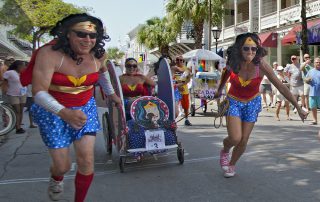
Drag racers don’t usually wear hot-pink feather boas, sparkling silver gowns or feather-trimmed boots — unless they’re contestants in Key West’s Great Conch Republic Drag Race, a madcap marathon that takes place each April.

In the Conch Republic, "drag racing" is not for the faint of heart. (Photos by Rob O'Neal/Florida Keys News Bureau

In the Conch Republic, "drag racing" is not for the faint of heart -- or weak of ankle. (Photos by Rob O'Neal/Florida Keys News Bureau)

That’s because this rowdy race isn’t designed for high-octane dragsters, but for high-heeled drag stars — female impersonators strutting their stuff complete with big hair, pancake makeup, false eyelashes and elaborate gowns or mini-dresses. (According to race organizers, however, tiaras are optional.)

Each year, more than a dozen daring divas compete in the offbeat event, which is presented by Key West’s Bourbon Street Complex to benefit the Florida Keys’ nonprofit Helpline organization.

“Officials” in black-and-white dresses designed to resemble checkered flags direct the action, while contestants race down a portion of Duval Street, the island city’s aptly nicknamed “main drag.”

In past years, they’ve even had to navigate an obstacle course of tires and trundle unwieldy shopping carts past the crowd. That crowd, by the way, usually numbers several hundred people (and they can get downright fierce about championing their favorites).

Navigating the course along Duval Street can be pretty "tiring" -- particularly in towering heels.

Navigating the course along Duval Street can be pretty "tiring" -- particularly for racers in towering heels.

The lively lovelies, handicapped based on the height of their heels above the regulation minimum three inches, are judged on their speed. Judges are also influenced by style (such as it is) — and generally aren’t above accepting a bribe or two to benefit Helpline.

While the energetic entrants TRY to sprint down the course, footwear malfunctions can slow their pace to an uneven stagger. (Sandals and stilettos are carefully prepped for the event, but it’s a rare race that doesn’t include at least one crash.) And a broken heel, the ultimate tragedy, can end a contestant’s dreams of victory.

Past years’ “athletes” have included a Lady Godiva wannabe with towering patent-leather boots, a perfectly-coiffed Barbie Doll clone and a goddess-sized diva whose purple grass skirt didn’t quite match her magenta curls. My personal favorite was a 2009 entrant fetchingly attired in a flowing pink gown, filmy wedding veil and full beard.

Some lively lovelies wear sporting attire with their heels -- a smart choice given the course's peculiar challenges..

Some lively lovelies wear sporting attire with their heels -- a smart choice given the course's peculiar challenges.

The drag challenge is part of Key West’s annual Conch Republic Independence Celebration that commemorates the Florida Keys’ 1982 secession from the United States — a symbolic action prompted by a U.S. Border Patrol checkpoint improperly erected at the head of the island chain.

The 10-day celebration also features a gaggle of other events showcasing the Keys’ independent and eccentric spirit.

Highlights include a sea battle with tall ships and weapons that range from water cannons to flying vegetables, the so-called world’s longest parade down Duval Street from the Atlantic Ocean to the Gulf of Mexico, and an open-air bed race billed as “the most fun you can have in bed with your clothes on.”

The 2010 Conch Republic Independence Celebration is set for April 16-25, with the drag race Saturday, April 17. If you’re in Key West at that time, “drag” yourself over to Duval Street and check out the action. Chances are you’ll have (ouch — wait for it) one “heel” of a good time.

Comments

High-Heel High Jinks Highlight Key West New Year’s Eve

Dorothy, you’re not in Kansas anymore.

While most visitors to Key West catch on to that fact fairly quickly, the island city’s New Year’s Eve celebration should provide definitive proof for anyone still in doubt.

Sushi, a.k.a. Key West resident Gary Marion, stars in the "drag queen drop" that welcomes the New Year in Key West. (Photo by Andy Newman/Florida Keys News Bureau)

Sushi, a.k.a. Key West resident Gary Marion, stars in the "drag queen drop" that welcomes the New Year in Key West. (Photos by Andy Newman/Florida Keys News Bureau)

Granted, the festivities include a ruby slipper. But instead of adorning Dorothy’s dainty foot, the sparkling shoe is a supersized power pump — and it serves as a chariot for legendary drag queen Sushi.

For more than 10 consecutive years Sushi, otherwise known as Key West resident Gary Marion, has starred in the New Year’s Eve festivities at the Bourbon Street Pub/New Orleans House complex at 724 Duval St. — while perched in a gigantic red high heel suspended high above the street.

This year will be no exception. Seconds before midnight on Dec. 31, the shoe bearing the lavishly gowned and coiffed Sushi will be lowered from the second-story balcony of the complex toward thousands of cheering spectators below.

Sushi (a.k.a. Gary Marion) reaches the end of her descent to Duval Street to welcome 2009.

Sushi reaches the end of her descent to Duval Street during the revelry welcoming 2009.

As midnight strikes and 2010 officially begins, she will land and pop the cork on a ceremonial bottle of champagne.

Even if you can’t make it to Key West this year for America’s southernmost New Year’s Eve celebration, you can still share in Sushi’s “shoe-nanigans” through the magic of cable TV.

In what has become a tradition over the past seven years, CNN plans to be in Key West with correspondent John Zarrella as a facet of the network’s live New Year’s Eve coverage hosted by Anderson Cooper and Kathy Griffin.

While Sushi presides over the revelry from her “throne” in the second-story shoe, the unflappable John Zarrella, a favorite of Key West audiences, will offer street-level commentary.

Appearances on CNN are just one high-profile outlet for the multitalented Sushi. She’s also the leader of an acclaimed troupe of drag performers called the 801 Girls who strut their stuff at the 801 Bourbon Bar on Duval. A skilled costume designer, she’s even been prominently featured in a book titled “Drag Queens at the 801 Cabaret.”

CNN correspondent John Zarrella, flanked by Kylie (right) and Colby, provides live on-air commentary each year during the "red shoe drop."

CNN correspondent John Zarrella provides live on-air commentary each year from the Key West festivities.

But it’s her role as a New Year’s Eve icon that has earned Sushi the most widespread fame. For starring in the island city’s “drag queen drop” — an offbeat take-off on New York City’s traditional New Year’s Eve ball drop in Times Square — she has even been mentioned in the “New York Times.”

“I never thought, growing up, that I’d be on television in a giant red heel,” confessed Sushi. “That’s not something that a young kid aspires to. But I’m so thankful that we live in a country that lets us do whatever we want to do as long as we don’t hurt anybody else.”

Comments

News Alert: Weather Channel Predicts Snow in the Lower Keys!

Crazy as it sounds, the Weather Channel is forecasting snow in the near-tropical Florida Keys on Christmas Day.

Weather Channel meteorologist Adam Berg (right) surprises Lower Keys resident Howard Livingston with the news that his family won the network's "Guaranteed White Christmas" contest.

Weather Channel meteorologist Adam Berg (right) surprises Lower Keys resident Howard Livingston with the news that his family won the network's "Guaranteed White Christmas" contest.

Specifically, though snow has never been recorded in the island chain, they’re forecasting it at the Lower Keys home of musician Howard Livingston — winner of the network’s nationwide “Guaranteed White Christmas” contest.

For Howard’s grand prize, The Weather Channel plans to orchestrate a massive manmade snowfall at his home overlooking the Atlantic Ocean. Meteorologist Adam Berg will be on hand to broadcast live coverage of the unprecedented “snow event” between 8 a.m. and 2 p.m. Christmas Day. It’s likely he’ll be broadcasting from the Lower Keys on Christmas Eve as well.

Michael Walker, Howard's grandson, starred in the family's video entry that earned them an unprecedented snowfall in the balmy Lower Keys.

Michael Walker, Howard's grandson, starred in the family's video entry that earned them an unprecedented snowfall in the balmy Lower Keys.

“I didn’t think we had a chance, because I didn’t think they could possibly make snow when it’s 80 degrees,” said Howard, who shares his home with his wife of two months, Cyndy, and their two dogs.

He found out differently when Adam and a Weather Channel crew flew in Dec. 13 to deliver the good news in person.

“When Adam Berg showed up, our jaws dropped because we recognized him,” he admitted. “I was flabbergasted.”

Howard was chosen from hundreds of contest entrants who submitted brief videos explaining why their families deserved a white Christmas. His 60-second piece shows the touring/recording musician and songwriter in his sunny waterfront yard, trying to make snow for his six-year-old grandson Michael Walker in a quirky blender powered by a 1952 Johnson outboard motor.

Using an offbeat blender/boat motor, Howard attempts to blend snow for his grandson Michael in the LIvingstons' winning video entry.

Using an offbeat blender/boat motor, Howard attempts to blend snow for his grandson Michael in the LIvingstons' winning video entry.

According to a Weather Channel spokesperson, on Christmas Howard’s yard will be blanketed by tons of snow created from shaved ice by a snowmaking and special effects company.

The white stuff is designed to be “packable,” making it ideal for shaping snowballs and snowmen (much to the delight of Michael, who has already figured out the accessories he needs to construct the perfect snowman).

Before learning about their surprise contest victory, the Livingstons were planning a family Christmas with Michael, Howard’s daughter and Michael’s mother Amanda Walker, her partner Tyler Hanson and their 11-month-old daughter Courtney Hanson, who live nearby.

Wearing Santa hats in anticipation of their white Christmas, the Livingston family awaits the first flakes in their sunny oceanfront yard.

Wearing Santa hats in anticipation of their white Christmas, the Livingston family awaits the first flakes in their sunny oceanfront yard.

“We generally spend Christmas at home with Michael, open gifts in the morning and cook some lobster on the grill,” said Howard.

Grinning broadly, he added, “We’re going to do the same thing this year, but with snow.”

The happy contest winner — whose infectious tropical rock tunes with his Mile Marker 24 Band include “Blame It On the Margaritas” and, coincidentally, “Local On the Eights” about The Weather Channel’s local forecast segments — also intends to fire up the offbeat blender/boat motor featured in his video entry.

On Christmas, however, Howard won’t need to employ the blender for making snow. Instead, just as he does onstage when he performs with Mile Marker 24, he’ll use it to blend margaritas for new and old friends.

Comments

Let’s Get Crabby in the Keys!

They look like the clawed talons of some oversized prehistoric bird. That is, if the bird was dreamed up by a Disney animation specialist with a strange sense of humor. But these claws, orange-red and pale yellow and black, come from the ocean instead of the sky.

Stone crabs are most abundant in the Florida Keys, and considered a seafood delicacy. (Photo by Andy Newman/Florida Keys News Bureau)

Stone crabs are most abundant in the Florida Keys, and considered a seafood delicacy. (Photo by Andy Newman/Florida Keys News Bureau)

They’re stone crab claws, offering sweet and scrumptious meat that’s among the Florida Keys’ most popular (and deservedly famous) delicacies. Since the stone crab season began Oct. 15, these savory claws have appeared prominently on the menus of top Keys restaurants — triggering a virtual stampede of savvy seafood aficionados.

Typically the claws are satisfyingly large, closer in size to a two-pound Maine lobster’s claws than a blue crab’s claws. Their commercial harvest dates back to the 1930s in Keys inshore waters, and the hard ocean floor and favorable environment support healthy local crab populations.

Stone crabs have the ability to regenerate their claws, making them a renewable resource. Fishermen generally pull the larger of the two claws and return the crab to its natural environment.

The claws are usually cooked immediately after being brought to the dock, by placing them in boiling water and then bringing the water back to a boil. Total cooking time is about 7 or 8 minutes.

Bennett Orr of Keys Fisheries plucks stone crabs out of a trap. (Photo by Andy Newman/Florida Keys News Bureau)

Bennett Orr of Keys Fisheries plucks stone crabs out of a trap. (Photo by Andy Newman/Florida Keys News Bureau)

What’s the secret to cracking the smooth, hard shell of the claw to get at the meat inside? Forget those squeeze-together shell crackers. Instead, gently smack the shell with the back of a spoon, and it will crack cleanly.

The traditional dip for stone crab claws is made from mustard (choose your favorite) with mayonnaise or sour cream, plus extras like Worcestershire or A-1 sauce and salt and pepper to taste.

One of the best spots in the Keys to savor stone crab is Keys Fisheries, located in Marathon. You’ll find the super-casual eatery in an industrial region off the Overseas Highway, nestled right beside the waterfront, surrounded by commercial docks and mountains of crab traps.

A favorite of locals in the know, the establishment has a funky atmosphere that communicates the essence of the island chain’s laidback style. Guests sit at wooden picnic tables on an outdoor patio facing the Gulf of Mexico. Décor includes fishing nets and nautical art, and the stone crab claws have that fresh-off-the-boat flavor that can’t be surpassed.

Between Oct. 15 and May 15, locals and visitors flock to restaurants and seafood markets to get crab claws, a sought-after delicacy at the Original Marathon Seafood Festival. (Photo by Rob O'Neal, Florida Keys News Bureau)

Stone crab claws are a sought-after delicacy at the Original Marathon Seafood Festival. (Photo by Rob O'Neal, Florida Keys News Bureau)

Stone crabs are prized so highly in the Keys that they star in several food festivals — like the Key Largo Stone Crab & Seafood Festival at the end of January. Organizers report that this yummy event is chock full of fresh stone crabs, conch, local seafood, music, entertainment and fun for the entire family.

The Original Marathon Seafood Festival is so popular that some dedicated diners even plan their Middle Keys vacations around it. For more than three decades, local fishermen and their families have prepared stone crab claws and other fresh indigenous seafood for thousands of attendees who flock to the March event. Not surprisingly, it has become a beloved Keys tradition.

Happily for those of us who crave the tasty claws, the stone crab season continues each year through May 15. So head for your favorite Keys seafood emporium … and “get cracking” on a plateful.

Comments

google

couk