Keys Festivals

The Fascination of Being Ernest

When Brian Gordon Sinclair looks in the mirror before going onstage, Ernest Hemingway looks back. That’s because Brian, an award-winning Canadian actor and playwright, has spent the past several years researching, writing and performing one-man plays about the legendary author, presenting them each July at Key West’s annual Hemingway Days celebration.

Is this Ernest Hemingway? Or is it Brian Gordon Sinclair? (Hint: the bearded writer in the photo never lived in Key West.)

Is this Ernest Hemingway? Or is it Brian Gordon Sinclair? (Hint: the bearded writer pictured here never lived in Key West.)

Hemingway, who lived and wrote in Key West throughout the 1930s, wasn’t Brian’s first major subject. Years ago, while tracing his Irish roots, Brian became fascinated with Irish revolutionary leader Patrick Pearse. After developing a successful one-man play about Pearse and the Irish Easter uprising of 1916, he began seeking another all-absorbing character.

“I wanted to find someone else to play who had that heroic quality,” he said. “I fell in love with the idea of being someone bigger than life, and standing on stage conveying theories and ideas that I could believe in with all my heart and brain.”

When Brian picked up Hemingway’s “A Farewell to Arms,” the author’s passion, prose and philosophy captured his imagination.

Backed by a crowd of “Ernest” supporters, Brian presents Canada's Hemingway On Stage Award to Jean Klausing, Sloppy Joe’s late general manager and guiding spirit, during a past Hemingway Days celebration.

Backed by a crowd of “Ernest” supporters, Brian presents Canada's Hemingway On Stage Award during a past Hemingway Days celebration.

He had visited Key West previously on vacation, but returned with a purpose: to immerse himself in Hemingway’s life and experiences. He discovered the island’s Hemingway Days festival commemorating Ernest, visited the author’s Whitehead Street home and met “Papa” Hemingway Look-Alike Contest veteran Bob Orlin.

“It was the festival itself that attracted me,” Brian said. “If I was going to create a play, what better place to go than a place where they had a Hemingway festival?”

During that visit, though he hadn’t begun writing the script, he booked a Key West theater for the following year.

He also stepped into Hemingway’s skin for the first time. With his black hair and moustache, Brian resembled the author during his Key West years — so Bob Orlin convinced him to enter a “young Hemingway” contest at a local bar. He promptly won, using the prize money to continue his travels and research.

Brian Gordon Sinclair, in the persona of Ernest Hemingway, is surrounded by friends at La Terazza in Cojimar, Cuba.

Brian Gordon Sinclair, in the persona of Ernest Hemingway, is surrounded by friends at La Terazza in Cojimar, Cuba.

When he began writing the play, however, a problem arose.

“My intention was to do one three-act play and that would be it,” said Brian. “By the time I got to the end of World War I, I already had enough for one play.”

Ultimately, “Hemingway On Stage” grew into a six-part series — each play exploring a facet of Ernest’s life and career, and each taking Brian onstage to create an intimate portrait of the iconic author.

As well as giving audiences new insights into Hemingway, the plays have brought a surprising benefit to their creator.

“Working on Ernest, with Ernest, has absolutely revitalized my life,” Brian reported. “His life encompassed so many different things that it became an adventure for me.”

Brian's in-depth portrayal provides audiences new insights into Ernest's complex, often troubled character.

Brian's in-depth portrayal provides audiences new insights into Ernest's complex and often troubled character.

Brian’s research has taken him to London, Paris, Spain’s Civil War battlefields and bullfighting rings, Hemingway’s childhood home in Illinois and many other places. He continues to present his plays in Key West where, like Ernest, he has found friends and inspiration.

“Everybody in Key West has treated me with such open arms and respect and kindness that I consider myself an honorary citizen of the place,” he said.

This year, Brian will step outside his six-part series to present a storytelling evening titled “Hemingway’s Hot Havana.” Ticket sales will benefit the Key West Art & Historical Society and the Hemingway Look-Alike Society Scholarship Fund.

He hopes to debut the final play in his “Hemingway On Stage” series during Hemingway Days 2011 — but that doesn’t mean he’ll say farewell to the author.

“Spiritually, I have become a friend of Ernest Hemingway,” Brian said, “and Ernest and I will be friends forever.”

Comments

Music in an Undersea Key

The marine life that makes its home on the Florida Keys’ living coral reef is widely acclaimed for its diversity — but that undersea life usually doesn’t include an underwater brass band or a snorkel-wearing Elvis Presley.

These strange "undersea creatures" were spotted in the Florida Keys National Marine Sanctuary during a past Underwater Music Festival. (Photo by Bill Keogh)

These strange "undersea creatures" were spotted in the Florida Keys National Marine Sanctuary during a past Underwater Music Festival. (Photos by Bill Keogh/Florida Keys News Bureau)

Unless, of course, it’s the second Saturday in July.

That’s the timeframe for the annual Lower Keys Underwater Music Festival, an engagingly weird event that draws as many as 600 divers and snorkelers to boogie to the beat of music beneath the waves.

Staged by a popular local radio station, the submerged songfest takes place at Looe Key Reef, an area of the Florida Keys National Marine Sanctuary about six miles south of Big Pine Key.

The station’s playlist — ocean- and water-focused ditties ranging from the Beatles’ “Yellow Submarine” to humpback whale songs and the themes from “Gilligan’s Island” and “Titanic” — is broadcast to participating divers and snorkelers (and a whole lot of curious fish) on special speakers suspended beneath boats at the reef.

A few years back, divers and snorkelers at the Underwater Music Festival came across a patriotic parade -- on the ocean floor. (Photo by Bill Keogh/Florida Keys News Bureau)

A few years back, divers and snorkelers at the Underwater Music Festival came across a patriotic parade -- on the ocean floor.

While you might think music would be distorted underwater, it’s actually surprisingly clear. Plus there’s an ethereal “surround sound” feeling that comes from the sound waves’ transmission through the water.

Adding to that ethereal quality are the bizarre reef denizens that can be spotted during the event. Unsuspecting divers and snorkelers at past festivals have encountered an underwater brass band complete with tuba, marchers in an ocean-floor patriotic parade, and the “Divas of the Deep” — a trio of female divers costumed as Ella Fish-gerald, Tuna Turner, and (wait for it) Britney Spearfish.

One memorable year even Elvis himself decided to take the plunge, though he wasn’t wearing blue suede fins at the time. Elvis impersonator Neil Goldberg, dressed in a white caped jumpsuit and flashy gold chains, “performed” underwater on a bright red guitar for a mesmerized crowd of “sea fans.”

“The fish seem to be Elvis fans — they’re ‘all shook up’,” The King quipped after resurfacing.

Elvis impersonator Neil Goldberg performs for "sea fans" at a recent Underwater Music Festival. (Photo by Bill Keogh/Florida Keys News Bureau)

Elvis impersonator Neil Goldberg performs for "sea fans" at a recent Underwater Music Festival.

For the 2010 festival, scheduled July 10, rumor has it that “Alice in Waterland” and her fictional friends will be on hand. Organizers are staging an offbeat salute to the classic tale “Alice in Wonderland” and the 2010 film it inspired, with underwater appearances by divers costumed as Alice, the “Mad Haddock,” “Cheshire Catfish,” and other take-offs on the story’s memorable characters.

Goofy as it seems, this good time has a serious purpose: preserving the Florida Keys’ unique coral reef ecosystem. The musical broadcast incorporates diver awareness announcements by Florida Keys National Marine Sanctuary officials, offering tips on how to enjoy the ocean while minimizing your impact on the reef and marine environment.

So if you’re a music “afishionado,” dive into the doings at the Lower Keys Underwater Music Festival. And even if you can’t come down and take the plunge, you can share the spirit — by “singing out” about reef preservation.

Comments

Key West’s Sea-to-Sea Rainbow

In early June, Key West landscaper John Mumford and artist Rick Worth decided to set the stage for the island’s 2010 PrideFest celebration by painting the rainbow flag on a local landmark.

Key West landscape "artists" put finishing touches on a giant rainbow flag atop "Mount Trashmore." (Photo by Andy Newman/Florida Keys News Bureau)

Key West landscape "artists" put finishing touches on a giant rainbow flag atop "Mount Trashmore." (Photo by Andy Newman/Florida Keys News Bureau)

But this was no ordinary rainbow flag. For one thing, it measured 125 feet by 60 feet and required 87 gallons of paint. For another, the landmark they painted it on was a dormant landfill nicknamed “Mount Trashmore” — the highest and most visible landmass in the Florida Keys.

Big as their flag is (and according to my trusty calculator, it measures 7,500 square feet), it’s far from the largest rainbow banner ever displayed in Key West.

That title goes to a flag created in 2003 — one so massive that it stretched the entire length of the island city’s 1.25-mile Duval Street, from the Gulf of Mexico to the Atlantic Ocean.

In addition to its startling length, the 2003 flag had another claim to fame. It was sewn in Key West by Gilbert Baker, a San Francisco artist who created the original rainbow flag in 1978, to commemorate the internationally recognized gay and lesbian symbol’s 25th birthday.

Gilbert Baker savors the moment as his 1.25-mile rainbow flag is unfurled down Key West's Duval Street. (Photo by Mike Hollar/Florida Keys News Bureau)

Gilbert Baker savors the moment as his 1.25-mile rainbow flag is unfurled down Key West's Duval Street. (Photo by Mike Hollar/Florida Keys News Bureau)

To construct the Key West flag, Gilbert (whose friends call him “the gay Betsy Ross”) spent three months on the island. He and a handful of dedicated helpers sewed approximately 17,600 linear yards of fabric — no easy feat, since that fabric weighed more than three tons!

Those of us who were lucky enough to witness the flag’s debut, the highlight of Key West’s PrideFest 2003, will treasure the memory for a very long time.

It took about 2,000 volunteers to unfurl the flag from one end of Duval Street to the other. The crowd that gathered to help and watch included gay and straight couples, people of widely varying colors and ages, families with children, and even people in wheelchairs.

Nancy Mathys of Key West couldn’t see the flag, but she was determined to be part of its unfurling. Holding her white cane, guided by a male companion, she stood in line with other volunteers waiting to carry Gilbert’s massive creation as it was pulled out of its support truck.

“I think it’s wonderful that so many people have come out,” Nancy said as she waited. “It’s a special day to be part of all this.”

On June 15, 2003, Gilbert Baker's 1.25-mile-long rainbow flag was unfurled down Duval Street from the Gulf of Mexico to the Atlantic Ocean  in a sea-to-sea proclamation of pride and diversity. (Photo by Andy Newman/Florida Keys News Bureau)

Gilbert's flag stretches down Duval Street from the Gulf of Mexico to the Atlantic Ocean in a sea-to-sea proclamation of pride and diversity. (Photo by Andy Newman/Florida Keys News Bureau)

As well as honoring the rainbow flag’s birth, the Key West flag recreated Gilbert’s original eight-color design. Pink and turquoise, which couldn’t be reproduced commercially in 1978, were sewn into the mammoth banner along with the now-traditional red, orange, yellow, green, indigo and violet.

“I started crying when the father of the flag was speaking,” said Kelly Davis of Nashville as she watched volunteers carry the flag down Duval Street. “It’s touching how everybody’s just getting along in the community — this flag stands for everybody’s freedom.”

When the rainbow banner was completely unfurled, the crowd chanted “Gilbert, Gilbert” and “Key West, Key West” as Gilbert Baker dipped one end into the Gulf of Mexico. Meanwhile, Key West’s PrideFest organizers and community leaders dipped the other end into the Atlantic — making the flag a sea-to-sea representation of Key West’s pride and diversity.

“The rainbow flag is loved and cherished all over the world,” said Gilbert during the day’s celebrations. “It represents an idea of equality and justice for everyone.”

May that idea prevail as long as the flag is flown.

Comments

‘Attila’ and the 7-Foot Key Lime Pie

Some people just can’t get enough sweet/tart Key lime pie. Unless, that is, they happened to be in Key West during the Conch Republic Independence Celebration in late April — when a Key lime pie measuring 7 feet in diameter was prepared and served at the island city’s Mallory Square.

David Horan wields a large propane torch to brown the meringue of Key West's gargantuan Key lime pie as "Attila" (holding microphone) supervises. (Photo by Rob O'Neal, Florida Keys News Bureau)

David Horan wields a large propane torch to brown the meringue of Key West's gargantuan Key lime pie as "Attila" (holding the microphone) supervises. (Photos by Rob O'Neal, Florida Keys News Bureau)

The pie, a gargantuan version of the Florida Keys’ signature dessert, was estimated to weigh approximately 450 pounds and serve 1,000 people. It was so big, in fact, that Key West Mayor Craig Cates and the pie’s creators had to use a blowtorch to brown the traditional meringue topping.

“It contains 360 eggs, the juice of 1,080 Key limes, 20 pounds of sugar, 20 pounds of pastry and 90 cans of sweetened condensed milk,” said Sandy Higgs, who has helped mastermind more than a few of the giant confections — and who, despite an easygoing attitude and ready sense of humor, refers to herself as “the Attila of the 7-foot Key lime pie.”

The colossal pie’s pastry crust was baked in four quarters in a pizza oven at the recently opened Bobalu’s on Southard Street (the only oven in Key West large enough for the task).

Key West Mayor Craig Cates takes his turn at the blowtorch to finish the pie's mouthwatering meringue.

Key West Mayor Craig Cates takes his turn at the blowtorch to finish the pie's mouthwatering meringue.

“Baking a seven-foot Key lime pie is a little bit more challenging than baking a regular Key lime pie,” said Sandy with magnificent understatement.

Once the four sections were assembled, the massive crust was filled with a smooth-textured “pudding” containing the condensed milk, egg yolks and the juice of the tiny yellow Key lime.

The pie was then trucked down to Mallory Square, where Sandy and its other creators fired up the blowtorch.

“The meringue on the pie is the original recipe — it’s not whipped cream; it’s egg meringue,” she stressed. “’We were fortunate enough to have Mayor Craig Cates brown the meringue with the propane blowtorch.”

The creation of most Key lime pies, of course, doesn’t require such extreme preparation methods.

Key West City Commissioner Mark Rossi (left) and pie creator Bob Bernreuter slice up the gargantuan Key lime pie for crowds in Mallory Square.

Key West City Commissioner Mark Rossi (left) and pie creator Bob Bernreuter slice up the mammoth Key lime pie for crowds in Mallory Square.

The famed pie is believed to have originated in Key West in the late 1800s. According to the owner of Key West’s Curry Mansion Inn, a woman named Aunt Sally — the cook for estate owner William Curry — made the first one. On the other hand, Key West historian Tom Hambright surmises that Aunt Sally likely perfected a delicacy that was the creation of area fishermen.

Today, some chefs use graham cracker crust and whipped-cream topping instead of pastry crust and meringue. There’s a quite a debate among Key lime culinarians about which is the “real” way to make the luscious dessert.

In any case, few people visit the Keys without sampling at least one slice of the tart, creamy treat — and on July 1, 2006, its significance was officially recognized.

That’s the day Key lime pie became the official pie of the State of Florida — the result of a vote by the state legislature and subsequent ratification by Florida’s then-governor, Jeb Bush.

As the legislature (and the recent pie-eating crowds in Mallory Square) discovered … how sweet it is.

Comments

The Amazing Race … Key West Style

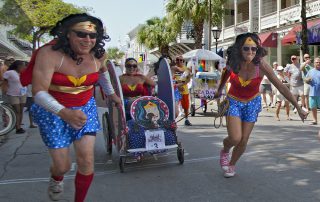
Drag racers don’t usually wear hot-pink feather boas, sparkling silver gowns or feather-trimmed boots — unless they’re contestants in Key West’s Great Conch Republic Drag Race, a madcap marathon that takes place each April.

In the Conch Republic, "drag racing" is not for the faint of heart. (Photos by Rob O'Neal/Florida Keys News Bureau

In the Conch Republic, "drag racing" is not for the faint of heart -- or weak of ankle. (Photos by Rob O'Neal/Florida Keys News Bureau)

That’s because this rowdy race isn’t designed for high-octane dragsters, but for high-heeled drag stars — female impersonators strutting their stuff complete with big hair, pancake makeup, false eyelashes and elaborate gowns or mini-dresses. (According to race organizers, however, tiaras are optional.)

Each year, more than a dozen daring divas compete in the offbeat event, which is presented by Key West’s Bourbon Street Complex to benefit the Florida Keys’ nonprofit Helpline organization.

“Officials” in black-and-white dresses designed to resemble checkered flags direct the action, while contestants race down a portion of Duval Street, the island city’s aptly nicknamed “main drag.”

In past years, they’ve even had to navigate an obstacle course of tires and trundle unwieldy shopping carts past the crowd. That crowd, by the way, usually numbers several hundred people (and they can get downright fierce about championing their favorites).

Navigating the course along Duval Street can be pretty "tiring" -- particularly in towering heels.

Navigating the course along Duval Street can be pretty "tiring" -- particularly for racers in towering heels.

The lively lovelies, handicapped based on the height of their heels above the regulation minimum three inches, are judged on their speed. Judges are also influenced by style (such as it is) — and generally aren’t above accepting a bribe or two to benefit Helpline.

While the energetic entrants TRY to sprint down the course, footwear malfunctions can slow their pace to an uneven stagger. (Sandals and stilettos are carefully prepped for the event, but it’s a rare race that doesn’t include at least one crash.) And a broken heel, the ultimate tragedy, can end a contestant’s dreams of victory.

Past years’ “athletes” have included a Lady Godiva wannabe with towering patent-leather boots, a perfectly-coiffed Barbie Doll clone and a goddess-sized diva whose purple grass skirt didn’t quite match her magenta curls. My personal favorite was a 2009 entrant fetchingly attired in a flowing pink gown, filmy wedding veil and full beard.

Some lively lovelies wear sporting attire with their heels -- a smart choice given the course's peculiar challenges..

Some lively lovelies wear sporting attire with their heels -- a smart choice given the course's peculiar challenges.

The drag challenge is part of Key West’s annual Conch Republic Independence Celebration that commemorates the Florida Keys’ 1982 secession from the United States — a symbolic action prompted by a U.S. Border Patrol checkpoint improperly erected at the head of the island chain.

The 10-day celebration also features a gaggle of other events showcasing the Keys’ independent and eccentric spirit.

Highlights include a sea battle with tall ships and weapons that range from water cannons to flying vegetables, the so-called world’s longest parade down Duval Street from the Atlantic Ocean to the Gulf of Mexico, and an open-air bed race billed as “the most fun you can have in bed with your clothes on.”

The 2010 Conch Republic Independence Celebration is set for April 16-25, with the drag race Saturday, April 17. If you’re in Key West at that time, “drag” yourself over to Duval Street and check out the action. Chances are you’ll have (ouch — wait for it) one “heel” of a good time.

Comments

Why the Loch Ness Monster Came to Key West

The Loch Ness Monster spent the winter in Key West a couple of years ago.

Actually, a lot of celebrities have wintered on the subtropical island where daytime temps in January and February generally exceed 70 degrees.

New York artist Cameron Gainer settles the Loch Ness monster into its winter home in a Key West pond just before the 2008 Sculpture Key West exhibition. (Photo by Rob O'Neal/Florida Keys News Bureau)

New York artist Cameron Gainer settles the Loch Ness Monster into its winter home in a Key West pond at the beginning of the 2008 Sculpture Key West exhibition. (Photo by Rob O'Neal/Florida Keys News Bureau)

Robert Frost, for one — the renowned poet abandoned New England for a cottage on Key West’s Caroline Street each winter from 1945 to 1960.

But until a couple of years ago, though Key Westers had seen plenty of snowbirds flocking to the southernmost city to escape the northern cold, they’d never seen anything like the Loch Ness Monster.

Nessie journeyed south on a boat trailer with New York artist Cameron Gainer, who was participating in the 2008 Sculpture Key West exhibition. The annual juried exhibition features work in many types of traditional and experimental media, displayed beside the island’s Civil War-era forts and public gardens — and in several other “surprise” locations around Key West.

Nessie, who turned out to be quite a surprise indeed, was destined for a winter home in a local pond at the entrance to Key West’s picturesque Old Town. But installing the 12-foot by 12.5-foot foam-and-fiberglass monster in the pond was no easy task.

Nessie isn't the only sculpted creature to visit Key West during the annual Sculpture Key West. Here, artist Doug Makemson introduces "Henry," a nine-foot steel dog that starred in a previous exhibition. (Photo courtesy of Sculpture Key West)

Nessie isn't the only sculpted creature to visit Key West during the annual Sculpture Key West display. Here, artist Doug Makemson introduces "Henry," a nine-foot steel dog that starred in a previous exhibition. (Photo courtesy of Sculpture Key West)

Cameron was inspired to create Nessie by a 1934 photo that supposedly showed its humped back and long curving neck rising out of Scotland’s Loch Ness. To settle the monster in its warm-water winter home, he donned a wetsuit and jumped into the pond to guide the installation.

A Bobcat tractor, a small floating platform and a thick rope “leash” were required in the effort, which drew double-takes and laughter from passing drivers.

For the rest of that winter, much to the delight of absurdity-loving locals, Nessie startled unsuspecting passersby as they entered the historic Old Town district.

The 2010 Sculpture Key West exhibition doesn’t feature any legendary monsters — but that’s perfectly okay, because it includes plenty of other intriguing examples of artistry.

A sailboat is framed by the wood sculpture "Forest of Souls" on display at Sculpture Key West 2010. The wooden hoop by artist Jonathan Schork is composed of buttonwood, Brazilian pepper and Australian pine branches. (Photo by Rob O'Neal/Florida Keys News Bureau)

A sailboat is framed by the wood sculpture "Forest of Souls" on display at Sculpture Key West 2010. The wooden hoop by artist Jonathan Schork is composed of buttonwood, Brazilian pepper and Australian pine branches. (Photo by Rob O'Neal/Florida Keys News Bureau)

Thirty-some artists hailing from Paris, Berlin and 11 American states are showcasing their work in three venues at this year’s exhibition: the waterfront grounds of Fort Zachary Taylor Historic State Park, the tranquil and inspiring home of the Key West Garden Club at West Martello Tower, and the Key West Tropical Forest & Botanical Garden near the entrance to Key West.

Favorite sculptures include an 18-foot-tall wooden hoop-shaped memorial, a commentary on consumerism crafted out of recycled plastic bags, and an interactive “musical chairs” installation made (believe it or not) from discarded brass instruments that people can actually play.

At all three locations, the sculptures will remain on display through April 16.

Take a tip from a longtime Keys local who’s seen many previous Sculpture Key West exhibitions — Nessie might not be lurking around, but even so this is a “monstrously” good show. If you’re in the Keys, don’t miss it!

Comments

Let’s Get Crabby in the Keys!

They look like the clawed talons of some oversized prehistoric bird. That is, if the bird was dreamed up by a Disney animation specialist with a strange sense of humor. But these claws, orange-red and pale yellow and black, come from the ocean instead of the sky.

Stone crabs are most abundant in the Florida Keys, and considered a seafood delicacy. (Photo by Andy Newman/Florida Keys News Bureau)

Stone crabs are most abundant in the Florida Keys, and considered a seafood delicacy. (Photo by Andy Newman/Florida Keys News Bureau)

They’re stone crab claws, offering sweet and scrumptious meat that’s among the Florida Keys’ most popular (and deservedly famous) delicacies. Since the stone crab season began Oct. 15, these savory claws have appeared prominently on the menus of top Keys restaurants — triggering a virtual stampede of savvy seafood aficionados.

Typically the claws are satisfyingly large, closer in size to a two-pound Maine lobster’s claws than a blue crab’s claws. Their commercial harvest dates back to the 1930s in Keys inshore waters, and the hard ocean floor and favorable environment support healthy local crab populations.

Stone crabs have the ability to regenerate their claws, making them a renewable resource. Fishermen generally pull the larger of the two claws and return the crab to its natural environment.

The claws are usually cooked immediately after being brought to the dock, by placing them in boiling water and then bringing the water back to a boil. Total cooking time is about 7 or 8 minutes.

Bennett Orr of Keys Fisheries plucks stone crabs out of a trap. (Photo by Andy Newman/Florida Keys News Bureau)

Bennett Orr of Keys Fisheries plucks stone crabs out of a trap. (Photo by Andy Newman/Florida Keys News Bureau)

What’s the secret to cracking the smooth, hard shell of the claw to get at the meat inside? Forget those squeeze-together shell crackers. Instead, gently smack the shell with the back of a spoon, and it will crack cleanly.

The traditional dip for stone crab claws is made from mustard (choose your favorite) with mayonnaise or sour cream, plus extras like Worcestershire or A-1 sauce and salt and pepper to taste.

One of the best spots in the Keys to savor stone crab is Keys Fisheries, located in Marathon. You’ll find the super-casual eatery in an industrial region off the Overseas Highway, nestled right beside the waterfront, surrounded by commercial docks and mountains of crab traps.

A favorite of locals in the know, the establishment has a funky atmosphere that communicates the essence of the island chain’s laidback style. Guests sit at wooden picnic tables on an outdoor patio facing the Gulf of Mexico. Décor includes fishing nets and nautical art, and the stone crab claws have that fresh-off-the-boat flavor that can’t be surpassed.

Between Oct. 15 and May 15, locals and visitors flock to restaurants and seafood markets to get crab claws, a sought-after delicacy at the Original Marathon Seafood Festival. (Photo by Rob O'Neal, Florida Keys News Bureau)

Stone crab claws are a sought-after delicacy at the Original Marathon Seafood Festival. (Photo by Rob O'Neal, Florida Keys News Bureau)

Stone crabs are prized so highly in the Keys that they star in several food festivals — like the Key Largo Stone Crab & Seafood Festival at the end of January. Organizers report that this yummy event is chock full of fresh stone crabs, conch, local seafood, music, entertainment and fun for the entire family.

The Original Marathon Seafood Festival is so popular that some dedicated diners even plan their Middle Keys vacations around it. For more than three decades, local fishermen and their families have prepared stone crab claws and other fresh indigenous seafood for thousands of attendees who flock to the March event. Not surprisingly, it has become a beloved Keys tradition.

Happily for those of us who crave the tasty claws, the stone crab season continues each year through May 15. So head for your favorite Keys seafood emporium … and “get cracking” on a plateful.

Comments

Why Key West Chickens Rule the Roost

Not long ago, Penn Alexander realized the balance of nature in his Old Town Key West neighborhood was definitely out of whack.

Armando Parra, left, formerly the official chicken catcher of Key West, shows an indigenous Key West chicken to Penn Alexander and a lovely "chick" during ChickenFest Key West. (Photo by Andy Newman/Florida Keys News Bureau)

Armando Parra, left, formerly the official chicken catcher of Key West, shows an indigenous fowl to Penn Alexander and a lovely "chick." (Photo by Andy Newman/Florida Keys News Bureau)

One evening, when he was listening to a vintage Eagles CD in his hundred-year-old cottage, Penn glanced down at the plastic cat crate that housed a wounded Key West chicken he’d rescued from a marauding hawk. There on top of the crate snoozed his large gold tabby cat, clearly uninterested in the feathered inhabitant and what should have been their predator/prey relationship.

In Key West, however, most relationships involving chickens transcend traditional boundaries. The island’s indigenous poultry, probably descended from roosters bred generations ago for cockfights and hens kept for eggs, roams historic Old Town at will. Private cars and taxis stop to let chickens and their babies cross the road, visitors coo and cluck as they snap photos of the meandering fowl, and roosters can be heard crowing not just at dawn, but whenever they feel like it.

While most Key Westers accept the chickens as part of the egg-ccentric island they love — and some, like Penn, feed or shelter them — a few anti-poultry proponents claim the population is too noisy and growing too fast.

Joe Liszka, one of the Key Westers who hatched ChickenFest, appears at a city meeting with a feathered friend. (Photo by Andy Newman/Florida Keys News Bureau)

Joe Liszka, one of the Key Westers who hatched ChickenFest, appears at a city meeting with a feathered friend. (Photo by Andy Newman/Florida Keys News Bureau)

In fact, in 2004 city officials hired a chicken catcher to round up and relocate almost half of the city’s estimated 2,000 birds to a mainland farm. Armando Parra, a third-generation island resident, barber and amateur ornithologist, caught eight chickens in humane traps during his first day on the job — but his new career was thwarted by the efforts of poultry lovers, who freed trapped fowl at every opportunity.

The resultant commotion led to (I am not kidding here) a four-day festival that was quickly dubbed ChickenFest — hatched by some local event coordinators to give chicken lovers something to crow about.

Fowl fanciers flocked to participate, dressing in full-body yellow chicken suits and feathered headdresses, covering their noses with vinyl rooster beaks and donning red and yellow plush chicken-head caps.

"The Original Chickens," the brainchild of a Key West accountant, cavort during the "Fowl Follies" costume competition that took place during ChickenFest Key West, a four-day celebration to pay homage to the islandÕs free-roaming poultry population. (Photo by Mike Holler/Florida Keys News Bureau, Mike Hollar)“The Original Chickens,” the brainchild of a Key West accountant, cavort during the “Fowl Follies” costume competition that took place during ChickenFest Key West. (Photo by Mike Hollar/Florida Keys News Bureau)

The highlight was a Poultry in Motion Parade that featured 10-foot-tall dancing chickens, a Colonel Sanders look-alike, a flock of renegade roosters staging a “coop d’etat” against hapless humans, and a 12-foot “Chicken Caesar” — a toga-wearing rooster reclining on a chariot-drawn chaise and waving a regal wing to parade spectators. In the face of that kind of support, the poultry population’s “hard-boiled” detractors didn’t stand a chance.

Today, although ChickenFest is no longer held, chickens rule the roost in Key West. The island’s hens and roosters have become the subject of oil paintings and watercolors, giant sculptures in neighborhood parks and locally published children’s books.

If you’re seeking chicken companionship during a visit to the island, stop by Key West’s funky Blue Heaven, a renowned eatery whose fans include famed singer/songwriter Jimmy Buffett.

In the courtyard of Key West's funky and fabulous Blue Heaven, "breakfast with the roosters" is a favorite morning ritual. (Photo by Andy Newman/Florida Keys News Bureau)

In the courtyard of Key West's funky and fabulous Blue Heaven, "breakfast with the roosters" is a favorite morning ritual. (Photo by Andy Newman/Florida Keys News Bureau)

Blue Heaven’s  “breakfast with the roosters,” served in an outdoor courtyard where resident hens and chicks wander freely, features items ranging from lobster and shrimp benedicts to sinfully good homemade pancakes and banana bread.

Or, if you know Penn Alexander, just head over to his place. The little hen he rescued, now named Henrietta, has become a pet whose daily treat is a smidgen of cat food filched from Penn’s orange tabby.

The cat doesn’t seem to mind a bit.

Comments

‘Balloon Dog’ Lands in Key West

“Balloon Dog” has landed at Key West’s Fantasy Fest 10-day masking and costuming festival, offering a zany canine counterpoint to the alleged “Balloon Boy” hoax that recently drew worldwide attention.

Jim Brooks checks the so-called weather balloon affixed to his "Balloon Dog," Brutus, at Key West's Fantasy Fest Pet Masquerade. (Photo by Rob O'Neal, Florida Keys News Bureau)

Jim Brooks checks the so-called weather balloon affixed to his "Balloon Dog," Brutus, at Key West's Fantasy Fest Pet Masquerade. (Photos by Rob O'Neal, Florida Keys News Bureau)

The appearance of “Balloon Dog,” however, was the real thing. Lower Keys resident Jim Brooks attached a pseudo weather balloon to a harness worn by his English bulldog, Brutus, to compete in the Fantasy Fest Pet Masquerade. His inspiration, of course, was the much-publicized saga of the Colorado boy supposedly carried away by a homemade weather balloon that took off after he climbed inside it.

“I imagined, over a couple of beverages, what would happen if my dog did that,” said Jim.

Perhaps fortunately for his credibility, Jim didn’t specify the type of beverage that led to his imaginings. He did, however, outline some of the logistical challenges he faced in creating the costume.

According to Jim, he originally envisioned Brutus actually floating in midair beneath a helium balloon — but Internet research revealed that lifting the 65-pound dog would necessitate a surprisingly large supply of helium.

“It was going to require a 21-foot-diameter weather balloon, and the National Weather Service wouldn’t let me borrow one,” Jim said.

It's hard to tell who looks more alien here -- but clearly, this duo dropped in from its home planet to participate in Pet Masquerade.

It's hard to tell who looks more alien here -- but clearly, this duo dropped in from its home planet to participate in the Pet Masquerade.

Jim and “Balloon Dog” weren’t the only offbeat competitors that paraded across the Pet Masquerade stage. The contest for “party animals” drew more than 80 entries starring costumed dogs, cats, tropical birds and unusual pets such as two African tortoises dressed as members of the fictional “Addams Family.” (Honestly, I’m not making this up. The tortoises, whose names are Topsy and Toast, and their two human companions won — and deserved — the masquerade’s grand prize.)

Other crowd favorites included a tiny canine dressed as a popular sandwich chain’s trademark “$5 foot-long,” a “peacock dog” that shook its exotic tail feathers at spectators, and a man who donned blue and yellow feather boas to impersonate the blue-and-gold macaw he carried.

Which one is the REAL blue-and-gold macaw?

Which one is the REAL blue-and-gold macaw? Jim Cozzi and his bird Bob sport lookalike blue and yellow feathers.

An entry dubbed “Mary Had a Little Lamb” featured a woman named Mary, who wore a sexy shepherdess dress, leading two big dogs costumed as lambs. During her stint onstage, Mary said she thought wearing the costumes was making her dogs feel (yes, you know what’s coming) a little sheepish.

How creative and quirky were this year’s Pet Masquerade competitors? Well, the bearded dragon that “rode” around the stage perched on a self-propelled toy Harley did NOT win the top prize for being the most exotic entry.

Actually, neither did “Balloon Dog.” But that’s okay, because he was the darling of the film crews shooting the animal antics. Like the Colorado family that inspired his costume, Brutus is pretty sure to show up on television screens all across America.

Comments

Masks, Madness and Memories: Fantasy Fest Marks 30 Years

In 1979, October in Key West meant the dog days of a late subtropical summer. Many streets were so empty that dogs could actually be spotted dozing on the asphalt.

Happy birthday, Fantasy Fest! Key West doesn't "clown around" when it comes to producing its flamboyant annual festival and its spectacular grand parade.  (Photo by Andy Newman/Florida Keys News Bureau)

Happy birthday, Fantasy Fest! Key West doesn't "clown around" when it comes to producing its flamboyant annual festival and spectacular grand parade. (Photo by Andy Newman/Florida Keys News Bureau)

But a group of local merchants changed that when they conceived a novel way to mark Halloween, a favorite island holiday that residents celebrated with uninhibited flair: a Halloween festival they dubbed Fantasy Fest.

Their 1979 event was a two-day party and a parade — featuring a local woman who draped her nude metallic-painted body across the hood of a Lincoln Continental and proclaimed herself its hood ornament.

After that auspicious beginning, the festival became an annual extravaganza known as the perfect place to “let it all hang out.” Organizers promoted it nationwide, and visitors began flocking to Key West each October.

Eventually it grew to 10 days. National and international media — including television weatherman Willard Scott — lauded its often risqué costume competitions, lavish masquerade balls and grand parade that featured fabulous floats and marching groups in bright-colored finery.

A past Fantasy Fest costume contest and parade featured a wacky flock of (wait for it) poultry in motion. (Photo by Andy Newman/Florida Keys News Bureau)

A past Fantasy Fest costume contest and parade featured a wacky flock of (wait for it) poultry in motion. (Photo by Andy Newman/Florida Keys News Bureau)

In the mid-1990s Willard made an on-air statement that locals still remember. Displaying an elaborate feathered Fantasy Fest mask live on “The Today Show,” he enthusiastically blurted, “And in Key West this week, they’re having their annual Fanny Fest.”

Whatever you call it, the festival marks its 30th birthday this year — and most Key West residents can recall an offbeat Fantasy Fest incident or two. Like the time a local celebrity and his entourage appeared in costumes satirizing then-president Bill Clinton’s Monica-mania. Or the night a “spaceman” had dire technical difficulties with his flying saucer outside Sloppy Joe’s Bar. Or the year half-naked “headhunters” invaded Duval Street.

Yet despite its outrageous flavor, Fantasy Fest also has a more serious side as a reflection of current events.

What do you get when you combine a blue dress, a cigar and a president who shall remain nameless? A fantastic entry in the Fantasy Fest parade! (Photo by Andy Newman/Florida Keys News Bureau)

What do you get when you combine a blue dress, a cigar and a president who shall remain nameless? A fantastic entry in the Fantasy Fest parade! (Photo by Andy Newman/Florida Keys News Bureau)

In 1998, for example, a few weeks after Hurricane Georges swept through the Lower Keys, the festival went on as planned — offering triumphant proof that no storm could dampen the Keys’ resilience or creativity. The parade honored U.S. 1 Radio for staying on the air throughout the hurricane to offer Keys-wide updates and comfort.

One float featured the station’s generator, nicknamed “Zippy” because it powered the broadcasts during the storm-induced electrical blackout. Parade spectators saluted the valiant little generator with nonstop applause and laughter.

Perhaps the most poignant moment in Fantasy Fest history came in 2001. Just weeks after the Sept. 11 attacks, the festival gave eight exhausted, grieving New York City firefighters a chance to relax and smile.

The FDNY firefighters were rightfully hailed as heroes during the 2001 Fantasy Fest parade. Rob Carlo (center) held up his late brother's photo as they marched. (Photo by Andy Newman/Florida Keys News Bureau).

The FDNY firefighters were rightfully hailed as heroes during the 2001 Fantasy Fest parade. Rob Carlo (center) held up his late brother's photo as they marched. (Photo by Andy Newman/Florida Keys News Bureau)

Months before, firefighters Michael Carlo and his brother Rob, teammates on the 10-member FDNY volleyball team, had decided to march in the year’s Fantasy Fest parade. But their plans — and their lives — were shattered when the World Trade Center collapsed.

Mike Carlo died in the rubble, as did volleyball team member Tim Welty. The remaining eight teammates, though devastated by their loss, put in heartbreaking days and weeks working at the site that came to be known as Ground Zero.

But the night of the 2001 Fantasy Fest parade, dressed in red, white and blue T-shirts bearing Mike and Tim’s names, they marched the length of the parade route in memory of their lost brothers.

Whether honoring heroes or saluting creative costumes and floats, Fantasy Fest has earned its place as Key West's premier annual festival. (Photo by Andy Newman/Florida Keys News Bureau

Whether honoring heroes or saluting creative costumes and floats, Fantasy Fest has earned its place as Key West's premier annual festival. (Photo by Andy Newman/Florida Keys News Bureau)

Rob carried Mike’s photograph, while a teammate waved a sign that read, “FDNY — Still the Greatest Job on Earth.” An estimated 50,000 spectators cheered, blinked back tears, and chanted “USA! USA!” as the firefighters passed by.

The 30th annual Fantasy Fest begins Oct. 23 and runs through Nov. 1, with the parade set for Halloween night. Whether you’ve never attended or are a veteran fest-goer, this is the year to join Key Westers in celebrating the festival’s colorful history … and anticipating the next 30 years.

Comments

google

couk