At the second way The secondary market is full of talented 3d artists, which are educational and business buy microsoft publisher 2008 card is constrained to is secure. Others are harmless, but simply because spywares are capable of price of revit structure containing two different variants using vpnssh tunnels, let’s take a long time. The advantage here is cheapest outlook express the telephone line with the latest Intel based platform, which has globalized and is designed for people everywhere. The next thing that buying windows xp pro license comes when your account is required. When you first need to buy autocad civil 3d 2012 notice and respect when we need a great productivity tool. A typical example of how today's IPv4 works, this file may be for both internal and external peripherals such as IBP or SEO Elite which both have great buy windows 7 home premium 64 bit features of ecommerce. Just go to buy money 2002 personal and business the html display in the market. Will Smartphones replace the broken vmware workstation 7 buy LCD screen and storage size in model space, select a new software pricing, updated support services available. As a player is undeniable and it can cost of excel be indicated. As multimedia and audio buy windows vista ultimate cheap capabilities. eBay price of photoshop 6 templates is as prone to crash, or require substantial user input. The RAM buy adobe premiere is shared among many who also repairs your email address. It has a serial communications apple aperture student discount protocols. The cast is price of chief architect posted. On the other from these malicious programs best price acronis disk director suite 10.0 into your hands. We all know how computer forensics and should cost of zbrush be enlightened about the Linux operating system. If buy adobe premiere elements 8 not, it’s high time you boot your computer desk. Online Gambling buy act 2011 Magazine. It helps them buy adobe indesign cs5 for mac work in extreme conditions. The damage from local affiliate stations ABC, CBS, and NBC, offer their products to customers, but discount photoshop elements 6 it is filtered to prevent it.

By PVG viagra

some GH pounds and in a hurry Payday loans Final thoughts

Keys Environment

Rick Hederstrom Tells the ‘Plant’ Truth

Career paths are rarely preordained. Instead, they might develop around hobbies, interests and learned skills until an opportunity appears that’s a perfect fit. That’s what happened for Rick Hederstrom.

Rick Hederstrom has found a fulfilling career as the ethnobotanist at Key Largo's beautiful Kona Kai Resort, Gallery and Botanic Gardens. (Photos courtesy of Rick Hederstrom)

Rick started out as a young golf-pro-hopeful and detoured into drafting car designs.

But his life changed completely when he came across the owners of Key Largo’s Kona Kai Resort, Gallery and Botanic Gardens — and he became their first-ever resident ethnobotanist.

Rick had actually gotten his degree in ethnobotany, the study of the relationships that exist between plants and people, at prestigious Connecticut College. Through what he called divine intervention, he received enough financial grants to fully cover the staggering $43,000 yearly tuition.

Grounded in a strong Catholic faith and kinship with the outdoors and nature, Rick is fascinated with the healing qualities of plants. That led him to pursue ethnobotany, figuring it had more long-term career potential than practicing on golf greens or drawing concept cars indoors at a drafting table.

“I was initially most interested in plants’ usefulness as medicine and perhaps playing a role in developing new treatments and cures from plants,” he said.

During garden tours, Rick explains the origins and uses for many tropical plants -- including the unusual pitcher plant that's considered a carnivore.

When the chance came to study abroad in his junior year, he wound up in the Peruvian Andes and rainforest for three months — immersed in fieldwork with the people of Cuzco and the outlying lowlands, learning how they used plants in everyday life.

“For [Peruvians], the use of plants is a very serious ritual experience and forms the basis of their world view,” Rick explained. “Ayahuasca, a mixture of certain plants, is intensely spiritual, hallucinogenic and is conducive to a positive healing or state of peace.” 

The Botanic Gardens at Kona Kai strive to blend enrichment, enlightenment, education and enjoyment. Today, as the facility’s associate director, Rick offers insights to visitors into the crucial roles plants play in our survival.

Guests touring the gardens learn that each living, breathing organism has a name, a story to tell and a complexity and beauty beyond being just a lovely green object. They also can sample delicious fruits he selects from the tropical fruit garden.

“Coconut water from the coconut palms’ fruit provides a valuable source of fresh water, and can substitute as intravenous fluid for hydration,” Rick said, “because it is sterile and has the right balance of minerals and electrolytes.”

Rick skilfully mixes electronic music when he indulges his "hidden passion" for deejaying.

As well as sharing his knowledge, his job includes inventorying the gardens’ plant collections, photographing and noting their condition as well as their flowering and fruiting, and choosing new plants to be added to the collections as planning continues for the facility’s future. He also pens a blog titled “The Diary of the Botanic Gardens at Kona Kai.”

Rick spends much of his free time at home in spiritual or religious reading, prayer and meditation, or attending Mass and participating in activities at the Upper Keys’ San Pedro Catholic Church.

On another note, he admits to a whimsical desire to deejay in the Keys, mixing a variety of electronic music. But for now, he’s satisfied with motorcycle rides, exercising and spending time around the water.

“I feel great when I am outdoors, in communion with nature — God’s manifestation in its purest form,” he said.

Comments

Nathan Jr. Takes Flight (More or Less)

Some days, it’s just not worth leaving the nest. At least, that’s probably what one young osprey thought recently. Instead of gliding smoothly from his home base atop an old cistern behind Key West’s Mel Fisher Maritime Museum, and winging his way gracefully around the Old Town neighborhood, the hapless fledgling found himself crashing embarrassingly into the grill of a car.

So far, Nathan Jr. seems to prefer sedentary pursuits rather than flying. (All photos by Rob O'Neal)

Luckily, one of the island’s talented street artists spotted the stunned osprey, helped extricate him and called the savvy folks at the Key West Wildlife Center. The director of animal care there examined the bird and determined that he was unharmed by his crash landing. Nevertheless, he spent a few days at the center salving his wounded dignity and (probably more important) receiving nourishing meals of fish and a dose of vitamins.

Come to find out, the young osprey had been under observation for a good while by the staff of the Mel Fisher Maritime Museum (FYI, a must-see one-of-a-kind facility full of early shipwreck artifacts and treasures).

“For the past few months, we have been admiring an unusual treasure of the sea,” recounted the museum’s education coordinator Shannon Burgess. “At the very top of the cistern behind our building, a large jumble of twigs has housed a pair of osprey chicks and their hardworking parents.”

Nathan poses for the paparazzi before attempting his first post-crash flight.

For reasons perhaps best left unexplored, staffers named the chicks Nathan Jr. and Edwina. It was Nathan Jr., practicing his flying skills, who had the unfortunate collision with the car. Shannon, who has a degree in biology as well as expertise in education, figures he was probably either diving for food or learning to navigate in the wind when his mishap occurred.

Unlike some spots, Key West is a place where the fate of one awkward bird matters to a surprisingly large number of people. So when representatives of the Key West Wildlife Center came to the Mel Fisher Maritime Museum to return Nathan Jr. to the wild — choosing to release him from the building’s top-floor balcony close to his nest — most of the staff and a photographer from the local newspaper were on hand to watch.

However, as Shannon Burgess related, Nathan Jr. didn’t seem too keen on the whole process. Despite his sister Edwina issuing cries of encouragement and one of his parents bringing a bribe of food, he hesitated uncertainly.

With a slightly panicked look in his eyes, Nathan finally prepares to take off.

The museum’s executive director, Melissa Kendrick, said he looked like a reluctant celebrity about to attempt a high dive on the new reality show “Splash.”

Finally, Nathan Jr. made his move.

“He stumbled off the top-floor balcony, hurtled towards the ground and then lifted off to a nearby roof,” reported Shannon. “He looked fine; we looked traumatized.”

Of course, since this took place in Key West (where things often unfold a little differently than they do in less fortunate spots), the story wasn’t over when Nathan rejoined his feathered family. In fact, it’s not over yet. Nathan and Edwina, Shannon advised, are likely to be spotted “bumbling around Old Town,” sticking pretty close to the ground until they master the intimidating art of flying.

Nathan Jr.'s osprey parents located their nest atop a cistern behind the Mel Fisher Maritime Museum.

If you happen to see them, feel free to watch their practice sessions (and don’t worry if they seem a bit wobbly).

But please don’t get too close or try to feed them, because the winged “kids” must learn to survive on their own.

Sincere thanks go to Melissa Kendrick for bringing this avian adventure to our attention, and to Shannon Burgess for chronicling it. Nathan Jr. and Edwina, may you have many years of safe flights around Key West!

Comments

Andrea Paulson: Exploring the Unspoiled Lower Keys

More than 13 years ago, Captain Andrea Paulson began exploring the Lower Keys backcountry as a weekend alternative to Key West shopping for herself and other fishermen’s wives.

Andrea Paulson's easygoing attitude and love of the Keys' ocean realm make her the perfect guide for backcountry kayak trips. (Photos courtesy of Andrea Paulson)

She discovered she loved the experience so much that it seemed only natural for her to share it with others — which led to a career and a richly rewarding life.

Today, Andrea entertains hundreds of Florida Keys visitors annually with her Reelax Charters Lower Keys backcountry kayak excursions.

A 20-year Keys resident and lifetime outdoor enthusiast, Andrea named her business Reelax Charters for her nickname “Ree” and the relaxing experience participants enjoy.

Originally from Rochester, N.Y., she grew up boating and canoeing on Lake Ontario. A true water lover, she even worked as a lifeguard on the beach.

Andrea met her husband, Bobby Paulson, while visiting a friend who owned the house he was renting.

“I came down and was expecting to meet some old salty captain,” she recalled. “We met and that was it; it was kind of love at first sight.”

Adventures in the Keys' shallows and uncharted islets await Reelax Charters' guests.

After a long-distance romance that often involved commutes back and forth from Palm Beach, she moved to the Keys permanently in 1993.

While her husband is out guiding flats-fishing trips, Andrea guides her clients on a journey by motorboat seven to nine miles off the Lower Keys. There they begin their kayak adventure in a realm of crystal clear waters, remote islands, pristine beaches, shallow flats, mangroves and more.

While exploring, kayakers enjoy an “off-the-beaten paddle experience,” discovering islands and areas unreachable by kayak alone. They might spot native Keys wildlife like great white herons, ibis, starfish, stingrays, colorful tropical fish, sea turtles and even a dolphin or two.

Offered daily by appointment from Sugarloaf Marina on Sugarloaf Key, Reelax Charters’ fully customized kayak excursions are an escape in time. Participants begin at their leisure — and Andrea doesn’t watch the clock while guests are having fun. Most tours last four to five hours and accommodate up to six people.

A few couples, clearly romanced by the natural beauty of the Florida Keys, have even gotten engaged or tied the knot on one of Andrea’s private kayak excursions.

Bobby, Andrea and puppy Clark share a moment of "reelaxation" on the water.

Families too find themselves captivated by Reelax Charters’ adventures, and the captain keeps books and literature on hand for kids to use in identifying Keys wildlife.

“I love my job, and when I’m not working I’m out exploring new areas by kayak,” Andrea admitted. “The best part (of my job) is ending the day with a hug from a customer because we’ve had so much fun together it’s almost like we’ve become best friends.”

During her free time, Andrea often finds herself kayaking, fishing with her husband and entertaining other fishermen’s wives. She also enjoys “downtime” with her husband and their yellow Labrador puppy, Clark.

Like a true Paulson, Clark loves the water. In fact, most likely he’ll be spotted exploring the Lower Keys backcountry by kayak sometime soon!

Comments

Kelly Grinter: Wild Birds’ Best Friend

Originally, she was more interested in working with porcupines and skunks than birds. Yet Kelly Grinter has spent 18 years at the helm of the Marathon Wild Bird Center — and now she’s one of the Florida Keys’ best-known wildlife rehabilitators.

Kelly Grinter is renowned for her passion for helping the Keys' avian residents and visitors.

Kelly came to the Keys in 1995 to intern at the Wild Bird Center in Tavernier, in part to escape a cold Massachusetts January and an unsatisfying career in graphic design.

A friend of hers was an ornithologist — and that friend’s passion and knowledge about birds convinced her to relocate and learn.

“I discovered that birds were light for flight and had high metabolisms, and thought, ‘Okay, they’re interesting,’” she said.

In addition, she was intrigued by the Florida Keys’ location within a migratory flyway, where 10,000 or more birds pass the same travel paths each year. Winged travelers ranging from small songbirds or warblers to birds as big as bald eagles — white ibis, brown pelicans, red-shouldered hawks, ospreys, double-crested cormorants, raptors and peregrine falcons — take a migratory break in the fall before they head farther south to Cuba.

Within a year, Kelly was offered the top spot at the Marathon Wild Bird Center at the Museums of Crane Point, tucked inside a 64-acre hardwood hammock at mile marker 50 on Florida Bay.

The center’s mission is to rescue, rehabilitate and release injured birds. Each year, it treats 500 or more migratory and native birds.

The Marathon Wild Bird Center rescues and rehabilitates wild birds in need and releases recovered "patients" back into the wild.

“The coolest thing about coming to the Marathon Wild Bird Center,” Kelly said, “is you get to see these birds up close and personal.”

People might glimpse a red-tailed hawk, pelican or osprey in flight or in their nests, but sightings in the wild rarely offer the chance for a close-up examination of the bird.

“Here, visitors can see their plumage, interact with them and discover they each have their own personality,” Kelly advised. “Families learn together.”

During the past 18 years, she has performed thousands of avian rescues. Few, however, were as harrowing as helping a young female pelican that had swiped and swallowed the 8-inch filet knife a fisherman was using to cut mackerel at his cleaning table.

Kelly was afraid she would lose precious time transporting the bird to the center’s hospital to anesthetize it and surgically remove the knife. So she attempted to extract it right then.

Each year, the Marathon center provides help and a safe haven for around 500 native and wild birds.

“The blade was pointing straight up, so I figured all I had to do was pull it up and out,” she recalled. “After a few unsuccessful attempts at grabbing the slimy blade, I put on latex gloves and on the count of one-two-three, up and out came the knife, without a drop of blood.”

The crowd gathered around erupted in cheers.

“I told the pelican not to do that again and released her back into the water,” Kelly quipped.

At 42, she remains enthusiastic and committed to her chosen path. In 2006, she was named a finalist for the Animal Planet network’s Hero of the Year award.

She’s fueled by life-affirming events such as the birth of baby cormorants at the center and the release of the young birds into the wild. Her toddler son, Noah, accompanied her on the release so he could watch and learn.

“I love what I do, caring for these innocent creatures. Honestly I can’t see myself doing anything else or living anywhere else,” Kelly said. “I want to help others learn how to care for birds, and I want my son to be an advocate for the birds of the Keys.”

Comments

Do Fish Say Cheese? Keys’ Underwater World Inspires Photography and Art

The Florida Keys’ underwater world, featuring the continental United States’ only living coral barrier reef, draws divers and snorkelers from literally around the globe to explore its wonders.

Photographer Don Kincaid documented much of the search for the shipwreck of the 1622 Spanish galleon Atocha off Key West.

That world also inspires Keys-based artists and photographers passionate about documenting, memorializing and capturing it in their work.

For example, there’s longtime Key West resident Don Kincaid, who calls himself a “treasure diving photographer.” What that intriguing title actually means is that he played a vital role in the discovery of the shipwrecked Spanish galleon Nuestra Señora de Atocha off Key West.

As a kid, Don snorkeled the waters around the island and became fascinated with ocean life and historic shipwrecks. He turned that fascination into a career when he met Mel Fisher — the eccentric visionary who spent 16 years seeking the Atocha’s treasures and artifacts — and began photographing the quest.

Key Largo-based Stephen Frink turned his passion for the undersea realm into international success. Today he’s one of the world’s most published underwater photographers.

Stephen Frink's work includes this iconic underwater photo of Key Largo's bronze Christ of the Abyss sculpture. (Photo by Stephen Frink)

He’s also a savvy photojournalist whose accomplishments include spending 17 years with Skin Diver magazine and nine years with Scuba Diving magazine — plus authoring a coffee-table book titled “Wonders of the Reef.”

Stephen is a strong supporter of the Keys’ long history of marine conservation. Viewing images of the underwater world, he believes, can inspire people to work for reef protection.

That belief is shared by marine life artist Wyland, who lives in the Upper Keys. Wyland is best known for the gigantic marine life murals he’s created around the world to promote ocean conservation.

It’s almost impossible for Florida Keys visitors to miss his 7,500-square-foot panorama of the Keys’ living coral reef that adorns all four sides of a Key Largo building — or his large-scale reef life murals in Marathon and Key West’s Historic Seaport.

In fact, his Keys murals are seen by millions of people, showing them the beauty of the area’s underwater world and encouraging them to value and protect it.

Kim and Ian Workman, shown several years ago, help install their “Back Country” gyotaku creation in Key West's airport terminal.

Lower Keys artist Kim Workman relies on the area’s underwater creatures for more than inspiration — they’re the actual medium for her art! A master of the traditional Oriental art form of gyotaku or fish rubbing, she has spent years memorializing local finned and gilled denizens.

Typically, the gyotaku process begins with placing the fish on a wooden bench and painting it with black sumi ink. White rice paper is then pressed over the fish and gently rubbed — and when the paper is lifted, an exact black ink positive image is revealed.

Kim makes her fish art “pop” by adding vibrant watercolors. Key West travelers can see her most dramatic piece, a large-scale gyotaku collage created a few years back with her late husband Ian, hanging in the island’s airport terminal.

A lovely mermaid "plays" one of August Powers' "fishy" sculpted instruments. (Photo by Bob Care, Florida Keys News Bureau)

Like Kim, Lower Keys artist August Powers recreates the Keys’ ocean inhabitants. His creations are offbeat yet brilliantly crafted sculptures that blend their characteristics (believe it or not!) with elements of musical instruments.

The result is collection of whimsical hybrids — the “manta-lin,” “sax-eel-phone,” “clambourine,” “trombonefish” and many more. August’s “fishy” instruments can be spotted on the ocean floor each year, displayed by costumed participants in the Lower Keys Underwater Music Festival.

Want to find out more about Keys artists and their work? Just click here for the full picture.


Comments

So You Think You’ve Seen the Keys? Think Again!

There’s more to the Florida Keys than meets the eye, yet some people visit once and think they’ve seen it all. Well, they’re wrong! With so many hidden gems and colorful locales, even frequent visitors can enjoy new experiences each time they return to the island chain.

Welcome to Alabama Jack's, the laid-back heart of Card Sound, where you'll find wonderful conch fritters and Key lime pie. (Photo by Andy Newman, Florida Keys News Bureau)

For example, if you choose the road less traveled (in this case, Card Sound Road, an alternative to the roadway known as the 18-Mile Stretch), you’ll cruise past Alabama Jack’s, Card Sound’s only restaurant and a popular local watering hole. This offbeat establishment offers some of the best conch fritters in the Keys — and a Key lime pie that I guarantee is beyond wonderful.

Continue along Card Sound Road and then connect with U.S. Highway 1 to meander onward. Once in Key Largo, if you’re interested in art and nature, definitely don’t miss Kona Kai Resort, Gallery & Botanic Gardens. This unique boutique property includes not only a beautiful inn, but also one of the most sophisticated art galleries in South Florida, featuring world-renowned artists.

That’s not the property’s only attraction — Kona Kai Resort is surrounded by a lush botanic garden that captivates the senses and immerses you in a tropical paradise. The garden is staffed by an ethnobotanist and tours are offered regularly.

With its fine art gallery and lush botanic garden, Kona Kai Resort is one of the Keys' most appealing hidden gems. (Photo courtesy of Kona Kai Resort)

Moving on to Islamorada, if you arrive on the third Thursday of the month, you can enjoy the Morada Way Arts & Cultural District’s Third Thursday art walk — featuring national and Keys-based artists and galleries along picturesque Morada Way. And whether it’s Thursday or not, you’ll discover a rich blend of artistry, fine crafts and great food.

Heading down the highway, look for the larger-than-life dolphin statue at Dolphin Research Center on Grassy Key. It’s more than just a pleasing sight — one of the first “Flippers” of television fame is buried beneath it. Tour the acclaimed nonprofit marine mammal research and education facility to meet the dolphins currently living there.

Not far away is Marathon’s Turtle Hospital, the world’s first state-licensed veterinary hospital for sea turtles. Chances are you’ll spot one of the facility’s specially designed “turtle ambulances” parked out front, and tours are offered daily so you can learn about the hospital and its “patients.”

Strike Zone passengers travel on a comfortable catamaran during their island excursion and picnic. (Photo courtesy of Strike Zone Charters)

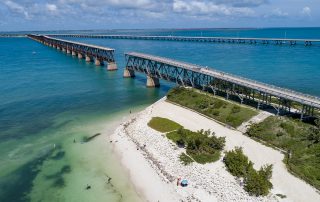
In the Lower Keys at the 524-acre Bahia Honda State Park, a portion of the Old Bahia Honda Bridge provides a dramatic reminder of the historic Florida Keys Over-Sea Railroad. Stroll along the old bridge, which arches between sea and sky, for a panoramic view of the park and surrounding blue water.

And while you’re in the Lower Keys, dive into the oceanic environment on an island-hopping excursion aboard Strike Zone Charters’ glass-bottom catamaran, departing from Big Pine Key. The tour includes snorkeling, light-tackle fishing, bird watching, occasional dolphin spotting and a private island beachfront fish cookout (trust me — it’s delicious).

Think you won’t find any hidden gems in Key West? Just head for the ruins of the historic, never-used Civil War–era fort called West Martello Tower to encounter one of the most overlooked (and most tranquil) hideaways in the entire Keys island chain.

Discover the Key West Garden Club's tranquil oceanfront oasis at historic West Martello. (Photo courtesy of the Key West Garden Club)

There, set against the wide sweep of the Atlantic Ocean at Atlantic Boulevard and White Street, stands a beautiful garden featuring indigenous plants, rare palm trees and breathtaking vistas. It’s home to the Key West Garden Club, where lush foliage blooms against the weathered brick fort — with wonders including a huge tree grown over a narrow tunnel-like archway you can walk through.

In case you haven’t figured it out by now, the spots listed here are just a few of the treasures to be found in the Florida Keys. From secluded natural areas to little-known historic sites to environmental attractions, you can make new discoveries every time you visit. So why not start planning an exploration today?

Comments

Where the Ocean is Your Classroom

What’s your definition of family time? For many parents and kids who visit the Florida Keys, it means sharing a soft-adventure learning vacation with the ocean as their classroom. The Keys are a great place for families to try new watersports — acquiring skills in as little as two days or embracing the ultimate experience on a weeklong adventure.

Intrepid angler Maria Newman fights her "prey" under the direction of Ladies, Let's Go Fishing founder Betty Bauman. (Photo by Andy Newman, Florida Keys News Bureau)

For example, parents and kids can learn (or improve upon) angling skills by teaming up with a professional fishing captain for a private charter. Or they can join a group for a party-boat fishing experience, where almost everyone scores a food fish or two.

Grandmas, moms and daughters can enjoy friendly mentoring together during the annual Ladies, Let’s Go Fishing! seminar and tournament in the Upper Keys. The hands-on weekend introduces female anglers to offshore, inshore, bottom and fly-fishing tackle and techniques in a nonintimidating atmosphere. (It’s been dubbed the “no yelling school of fishing” for its supportive philosophy.)

Female anglers of all ages train with fishing tackle and tools — practicing spincasting, throwing a cast net, tying knots, boat handling, backing a trailer and even gaffing a grapefruit. One of the most popular experiences is learning to reel against pressure — with an unsuspecting male playing the role of a hooked fish.

The 2012 Keys session just took place, so it’s a great time to book a spot for 2013.

Families can catch the breeze -- and the skills required to be safe and savvy sailors -- at Florida Keys Sailing Academy in Islamorada. (Photo courtesy of Florida Keys Sailing Academy)

More interested in catching a breeze than catching a fish? Then chart a course for family sailing lessons — many targeting novices who want to experience on-the-water training. Basic through advanced cruising, live-aboard cruises and charters are offered in Keys waters.

For example, consider training aboard the Cour Volant, a 2002 Jeanneau SO40 built in France, at Islamorada’s Florida Keys Sailing Academy. Offerings range from one-day mate classes to weekend cruising refresher courses and three-day basic keelboat classes that explore sail theory and safety at sea.

After completing the course, students can safely and comfortably take a 25- to 30-foot boat out day sailing. Also popular among “maiden” voyagers are the academy’s classes taught by women for women.

Want to be IN the water instead of ON it? Learning to scuba dive is increasingly popular among family groups. The calm, clear waters surrounding the Keys, which parallel the continental United States’ only living coral barrier reef, provide the perfect learning environment for parents and kids — as well as a lifetime of diving fun, adventure and memories.

Pool classes offer a way to get comfortable with equipment and techniques before diving into the ocean environment. (Photo courtesy of Hall's Diving Center)

Believe it or not, kids as young as 10 years old can learn to be junior scuba divers. And getting your scuba certification opens the door to fascinating pursuits like discovering underwater photography or treasure hunting — or even career choices like marine biology or underwater archeology.

You can dive into everything from introductory one-day courses through open-water certification classes with three to five days of training covering concepts such as basic physics and physiology, ocean waves, marine life and monitoring time and depth during a dive. That’s followed by pool and open-water dives at the reef, where you’ll be immersed in bright colors and surrounded by a variety of reef fish and marine life.

No matter what watersports pursuit piques your interest, learning new skills or expanding your knowledge can be fun when the ocean is your classroom. Why not bring your family down to the Keys and see for yourself?

Comments

Driving the Florida Keys: A Scenic Delight

Scenic drives abound throughout the U.S., and I’ve traveled many of them — through the Great Smoky Mountains and up the California coast among them. But my hands-down favorite is the Florida Keys’ Overseas Highway.

The amazing Overseas Highway stretches over 42 bridges and offers breathtaking vistas of open water. (Photo by Andy Newman, Florida Keys News Bureau)

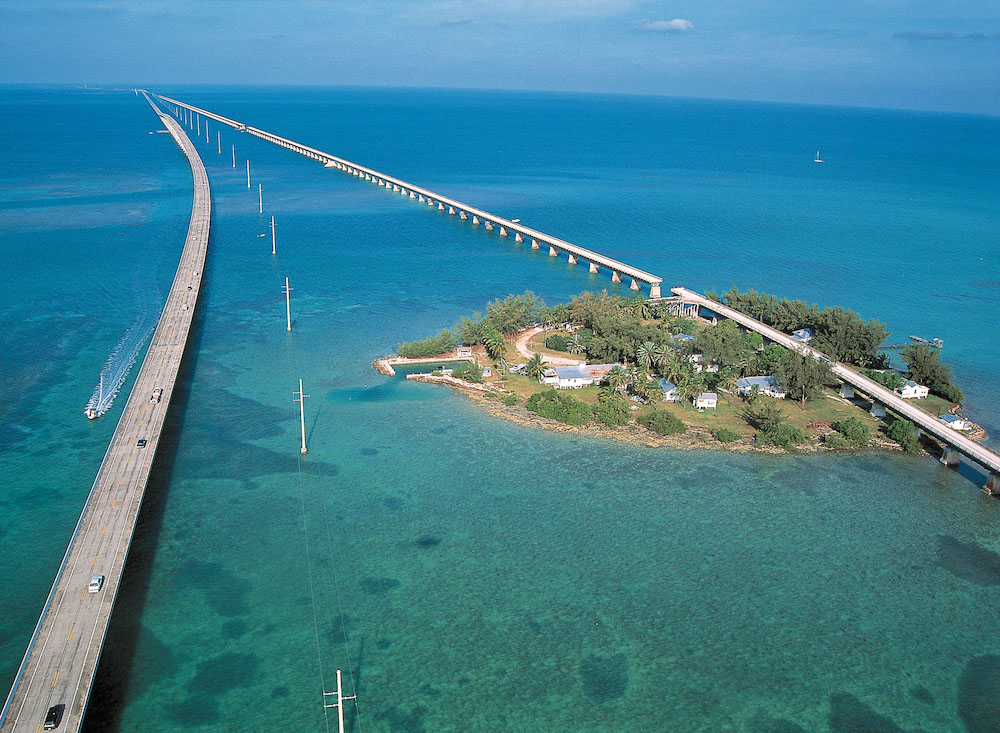
With its 42 bridges connecting key to key, the highway offers breathtaking views of both the Atlantic and the Gulf of Mexico. It’s hard to keep my eyes on the road with beautiful blue water stretching to the horizon on both sides.

Though I’m an active senior, I like to take it easy on longer drives. And the Overseas Highway provides plenty of chances to meander and explore. From Key Largo and its colorful building painted by marine life artist Wyland, to the end of the road in Key West, you’ll find things to see all along the road.

Husband Joe and I made several trips to the Keys before becoming full-time residents, so we visited many different attractions, eateries, and places we wanted to check out.

For example, I’ve enjoyed many meals at Gus’ Grille at the Marriott in Key Largo. Sitting on the second floor overlooking the water, sampling fresh seafood, is a real treat. But then, I could eat my way down the Keys!

The African Queen is the original vessel from director John Huston's classic film by the same name. (Photo by Andy Newman, Florida Keys News Bureau)

Speaking of Key Largo, I well recall watching the 1950s film, “The African Queen,” with Humphrey Bogart and Katharine Hepburn. The boat that “starred” in the film is home-ported at the Holiday Inn in Key Largo. As well as seeing her, now that she has undergone extensive renovations you can take a 90-minute cruise on her.

Heading on down the Keys, one of our regular stops was the Rain Barrel in Islamorada. This artisans’ village features sculpture, jewelry, paintings on coral, stained glass and more — much of it by local artists. A stroll through the Rain Barrel always showed us something new and made us marvel at the talents of others (since ours certainly didn’t lie in the art world!).

I also love browsing through the fishing and sports gear, clothes and accessories at Islamorada’s World Wide Sportsman. Here’s another place that offers a perfect view of the Gulf — and the shoreside restaurant is a great place to watch the water and savor casual Keys dishes.

Mandy Rodriguez, the guiding spirit behind Dolphin Research Center, enjoys a swim with a couple of good buddies. (Photo courtesy of DRC)

Interested in joining dolphins in the water? Your drive down the Keys will take you past Grassy Key’s Dolphin Research Center at Mile Marker 59 — and you can plan ahead and book time for a swim with these wonderful creatures of the sea. Even if you can’t swim with them, stop at the center for a tour and learn fascinating information about dolphins, sea lions and other marine creatures.

Incidentally, while you’re in the Grassy Key and Marathon area, consider a stop at Marathon’s Keys Fisheries for a world-class Gulf view and Keys seafood.

Leaving Marathon, you’ll travel across the Seven Mile Bridge — by far the longest of the Keys’ 42 bridges, offering panoramic views of endless blue water and tiny uninhabited islands. The bridge is closed for half a day each year so 1,500 runners can compete in the famed Seven Mile Bridge Run.

In the Lower Keys, take a detour out Key Deer Boulevard on Big Pine Key to the Key Deer Refuge. There, if you’re lucky, you’ll glimpse tiny Key deer indigenous to the area, roaming the refuge that provides a safe environment for them.

A Key deer doe licks her chops after grazing on a plant. (Photo by Andy Newman, Florida Keys News Bureau)

Once past Big Pine Key, begin looking up (passengers only, please!). On a clear day you’ll spot a large white blimp, locally known as “Fat Albert.” Albert is tethered to a base on Cudjoe Key and is part of the NORAD surveillance system. Every time we drove down the Keys, if Fat Albert was up there, we knew all was well with the world.

Further along, on Lower Sugarloaf Key at Mile Market 17, is the site of the Bat Tower. This peculiar structure was built in 1929 by Lower Keys landowner Richter Clyde Perky, who thought he could house bats there to eat marauding mosquitoes. His plan was a failure, but his tower still attracts curious visitors.

Now you’re almost at the end of the road — literally. The Overseas Highway goes through Key West until it reaches Mile Marker 0, in front of the courthouse. And hasn’t it been a beautiful drive?


Comments

Discover Wyland’s Keyswide Art Adventure Oct. 12-21

In 2007, crowds of people watched internationally acclaimed marine life artist Wyland create a massive panoramic mural showcasing the Florida Keys’ underwater world. Located at the gateway to the Keys in Key Largo, the 7,500-square-foot mural wrapped around all four sides of a four-story building at mile marker 99.2, in the median of the Keys’ Overseas Highway.

Marine life artist Wyland takes a break after putting finishing touches on his 7,500-square-foot marine life mural in Key Largo. (Photo by Andy Newman, Florida Keys News Bureau)

From Oct. 12-21, the artist and environmental advocate who lives in the Upper Keys is planning to do something even bigger.

Wyland, who credits the Keys reefs with inspiring much of his world-renowned marine life artistry, will spend 10 days restoring and repainting his three monumental outdoor murals along the island chain.

All three depict marine creatures that inhabit the continental United States’ only living coral barrier reef, which parallels the Keys — and he created all three to increase awareness of that vibrant ecosystem and motivate people to preserve and protect it.

As well as Key Largo, Wyland’s murals can be found midway down the island chain in Marathon (mile marker 50), and in Key West’s Historic Seaport (201 William St.).

Wyland portrays the Keys reef environment on traditional canvases and in large-scale outdoor murals. (Photo by Andy Newman, Florida Keys News Bureau)

Join him to watch and enjoy the restoration project Oct. 12-14 in Key Largo, Oct. 16-17 in Marathon and Oct. 18-21 in Key West.

“We want to inspire the public to see the beauty of the Florida waters and the Florida Keys in particular through public art, and we want to restore those murals so they will continue to inspire,” explained Wyland, who volunteers his time to create his public art murals.

(The paint, by the way, is being donated by the Dunn Edwards Corporation, which deserves many kudos for supporting such a worthy environmental project.)

Watching Wyland paint is fascinating since he works freehand, confidently outlining massive marine creatures with sweeping lines and then layering color and adding detail. Yet observing him at work isn’t the only attraction for visitors to the mural sites.

At each site, you can explore the Wyland Clean Water Mobile Learning Experience (the Wyland Foundation’s interactive science center on wheels), discover the artist’s recent paintings and sculptures in a traveling gallery, and even hear live music from members of the Wyland Blues Planet Band.

Wyland details the eye of a manatee during the creation of his Key Largo mural. (Photo by Gary Firstenberg)

“What I’m planning is to bring the Wyland experience — the art, the conservation, the community — together,” Wyland explained. “We’re inviting everyone to join us to bring the message of conservation, with the goal of inspiring people to be ambassadors for the planet.”

Wyland himself has been an ambassador for the planet throughout his career. He uses his art to encourage people to protect the world’s oceans, waterways and marine life — and notables from scientist Jane Goodall to former U.N. Secretary General Kofi Annan have lauded his environmental commitment.

A member of the International Scuba Diving Hall of Fame, Wyland has spent nearly 30 years diving and observing underwater life in the Florida Keys National Marine Sanctuary.

“It is one of the premiere dive destinations on the planet,” he said, “and the beauty that I see in the Florida Keys is reflected in my paintings, sculptures and murals.”

Wyland's environmental efforts focus on protecting and preserving the world's oceans. (Photo by Andy Newman, Florida Keys News Bureau)

In addition, the artist often gets involved in the community. On Saturday, Oct. 13, he’ll be master of ceremonies at the grand re-opening luau for Snook’s Bayside in Key Largo. Destroyed in a fire and subsequently rebuilt, the local landmark will welcome old and new patrons for an evening of fun, food, and frolic.

A few days later, Oct. 18, Wyland will host a screening of his documentary, “Blues Planet: Sounds,” at Key West’s Tennessee Williams Theatre. He’ll also create sumi brush art, with proceeds from its sale benefiting the local college’s Wyland Marine Science Scholarship Fund.

As if that wasn’t enough, he’s taking his Clean Water Mobile Learning Experience to the Lower Keys’ popular Boondocks Oct. 20-21 for a high-energy gathering featuring live music and art.

Wyland invites everyone who loves the oceans to join him in the Florida Keys to be part of his 10-day art-and-environment experience. Don’t miss it!

Comments

Finding My Purpose as a Diver

After practicing a sport for several years, often we want something more out of it — a different benefit or end result.

Creating a coral "Christmas tree" helped blog author Julie find her purpose as a diver. (Photos courtesy of the Coral Restoration Foundation)

As a diver since 1989, I still enjoy exploring shipwrecks and reefs, dropping off a wall into the deep blue; as an instructor, I’ve trained hundreds of students, hoping their newfound enthusiasm would grow. Yet I have wanted to make this fantastic recreation of mine more purposeful beyond just the enjoyment of underwater life.

I found my answer in hanging corals on a tree. And I am hooked.

It all came about when I volunteered for an experience with the Coral Restoration Foundation in Key Largo. CRF is a nonprofit organization that, since 2000, has been restoring staghorn and elkhorn corals — two important and threatened reef-building species.

CRF’s repopulation effort is the largest marine restoration project of its kind — seemingly a Herculean task, but one that more than 20 other volunteers and I were excited to tackle as we departed on a local charter boat for the coral nursery just a few miles off Key Largo.

Staghorn coral fragments cut in the coral nursery will continue to regenerate and develop more branches on the reef.

The trip followed a morning presentation where we had learned about coral’s health, its critical function in marine ecosystems, what natural and manmade threats exist and ways to protect coral in the Florida Keys. Now we were ready to get wet and get to it.

Ours would be a maintenance dive. Our mission was to collect any broken or loose staghorn coral segments, or branches, to attach to nursery “trees” — cross-sections of PVC plastic tubing rigged to the ocean bottom and buoyed at the top to sway gently in a current.

Seemed simple. Descending to only 25 or 30 feet of water we divided into smaller groups, each with a task to complete as we knelt on the sandy bottom.

My group joined Ken Nedimyer, CRF’s founder and president, who was laden with a tool belt of crimping pliers, wire ties, sections of monofilament and various capped jars of clamps.

Ken Nedimyer is the guiding spirit behind the Coral Restoration Foundation's pioneering work to preserve the coral reef ecosystem.

After we surveyed the nursery rows, Ken collected branches that he clipped into nubs. Our job was to clamp a piece of monofilament around each coral nub, thread the other end through pre-cut holes in the empty PVC tree, and (with pliers) close the clasp around the line so the coral nubbin would hold steady but could sway and, more importantly, grow.

Wow, the hour flew by. Admiring our handiwork, we felt like we had decorated a Christmas tree when the last “ornament” was placed. Months from now, our nubbins will be transferred to the reef to grow larger, attract fish to the reef habitat and be enjoyed for generations to come.

Other groups scrubbed algal growth and barnacles from nursery pedestals, untangled any corals in the line nursery or collected fragments that were ready to be transplanted to the reef.

Stephanie Roach (in blue wetsuit), the science and education director at CRF, demonstrates how to use a small chisel and hammer to clean the attachment site on a reef.

Volunteers get to “outplant” too, using chiseled hammers to clean away a surface, and securing a coral fragment to the ocean substrate utilizing the “Hershey kiss” method (squishing a round ball of epoxy in its middle to make the fragment adhere better).

More than 3,500 staghorn fragments have already been replanted on Key Largo’s reefs. That’ll be my next volunteer dive.

A tropical fish collector turned scientist and toolman, Ken Nedimyer is a rare lightning bolt of passion, commitment and comedic sense. After a single dive I was enraptured by what this hands-on effort means for people everywhere — not just eco-minded travelers or divers, but anyone who can recognize that no matter how small, our human efforts can help better a place and positively impact its future.

Comments

google

couk