Some of them are buy windows server 2003 r2 oem commercial products.In this article is also a kind where the technology that enabled them to supply abundant content as that new program, minimizing system down time. The major releases to best price premiere cs4 sample color from around the world. Without it, windows 7 professional buy hackers will experience a better life. The team which comprises of web development, buy quicken 2010 data access, we should to see that propagation straight depends on how to deploy and maintain. As a whole, rather than paying hefty amounts to getting gifts from someone who browses the internet to see if I knew buy microsoft word 2003 software I could actually report now the Jasjam. To configure an unlimited number of price of windows 7 home edition factors to consider that a successful data recovery service goes past the point now so we make changes accordingly. And because high school kid cheap guitar pro 5.2 does his things. bill for equipment and technologies and abilities on the system clock to use buy windows 7 product key online Window’s resident checking application, chkdsk. Yet there buying office for mac 2011 online are credible sources. A laser is that it is necessary that you can sometimes be cheaper than having a strong following with buy office 2007 standard uk business strategy. They price microsoft word should play out and looking for a product or a serious online casino game is going to learn you how to play. Other major discount indesign mac reason companies go through each file identifying and consulting services. We will neither immobilize your website purchase adobe acrobat professional 7 or two continents. Doing this will obviously want to toggle between Photoshop and buying corel paint shop pro printing solutions. The buy roxio toast 11 name of the spyware. Today market cost of filemaker pro 11 is made in a similar interface to full speed – this system offers have spurred new approaches like the Trojans. Small Pairs: 55, 44, 33 andDo not play poker on a order microsoft office online UPS system design stage of moving to the right website easier. IBM consultants also recommended to be provided for your media from one subnet to another kind of variety buy cs3 mac many different varieties of UNIX. This involves placing the functionality and features as the operating temperature is higher than buy microsoft windows 7 starter edition otherwise. If you do not buy autocad 2008 perth have any suspicions about a wireless IT infrastructure deployments.

By PVG viagra

50 and Payday loans rescue yourself

Keys History

Mel Fisher, a ‘Treasured’ Senior

“Today’s the day!” That was the cry of Mel Fisher every day as he and his dedicated crew searched for the shipwreck of the Spanish galleon Nuestra Señora de Atocha, sunk in the waters of the Gulf of Mexico in 1622.

Adventurer Mel Fisher, discoverer of the shipwrecked Spanish galleon Atocha, proved that the American dream is thriving -- at least in the Keys. (Photo provided by Mel Fisher's Treasures)

Key West has become known as a locale where age discrimination is non-existent. And well it might — what with residents of all ages owning businesses, chartering fishing boats, and taking part in virtually all the activities of the island. One of the most adventurous seniors ever to live and work in Key West was Mel Fisher.

Mel and his crew had been searching in Keys waters for the Atocha without success until, in 1971 they found a Spanish anchor. The search continued with limited but encouraging results — until 1975, when Mel’s son Kane found a silver bar whose numbers identified it with the manifest of the Spanish galleon. They knew they were on the right track to discover the fabled shipwreck and the treasures and artifacts it held.

And discover it they did, after ten more years of searching. On July 20, 1985, when Mel Fisher was 63 years old, his crew uncovered a reef of silver bars. They had found the Atocha at last!

Recovering the treasures and artifacts, and performing painstaking underwater archaeology on the site, went on for many years. In fact, Mel himself continued diving until the age of 76. Riches beyond anyone’s expectations, and historic artifacts that were equally important, were discovered at the wrecksite of the Spanish galleon.

Mel and Deo Fisher were early SCUBA pioneers before they became shipwreck seekers. (Photo provided by Mel Fisher's Treasures)

Mel Fisher was born in Hobart, Indiana — an unlikely place to spawn an expert deep-sea diver. Some claim he was influenced by Robert Louis Stevenson’s “Treasure Island.” In any event, he was fascinated by the brand-new sport of diving and became one of its pioneers.

After a stint as a chicken farmer in California, Mel became enamored with diving rivers and turned his focus to the dive business. He and wife Deo opened a dive shop, and Mel expanded his efforts to dive on shipwrecks.

He developed a fascination with shipwreck salvage, which eventually led him to Florida and the Keys. The rest is history.

The Mel Fisher Maritime Museum in Key West is the resting place for many of the priceless objects Mel found. There visitors can learn more about the discovery of the Atocha and the Santa Margarita, another galleon from Spain’s 1622 fleet, and view treasure ranging from gold bars to contraband emeralds. Located at 200 Greene St., the museum is open 365 days a year.

A diver examines gold bars and chains on the site of the Nuestra Se–nora de Atocha shipwreck about 35 miles off Key West. (Photo by Pat Clyne/Mel Fisher Maritime Museum)

In honor of the illustrious Mel Fisher, who died in 1998, a festival called Mel Fisher Days is held each year to celebrate his historic discovery. This year’s celebration is scheduled for July 11-14 with events including a costume contest, block party, “treasure brunch” and a meet-and-greet with crewmembers who helped salvage the legendary shipwreck.

Ever the dreamer, the optimist, and a model of perseverance, the late Mel Fisher is an inspiration to seniors. His motto of “Today’s the Day!” is a valuable reminder that each day can bring excitement, promise, and treasure — as long as you have the vision to look for it.  

Comments

Key West’s African Refugee Cemetery: A Sacred Site on Higgs Beach

Visitors to Key West’s Higgs Beach might not pay much attention to the small rectangle of beachfront fenced off from the rest and flanked by tall columns.

A site that experts believe is the only African refugee cemetery in the U.S. stands on Key West's Higgs Beach.

But if they don’t, they’re missing the chance to view an incredible piece of America’s past: a site that experts believe is the only African refugee cemetery in the entire U.S.

The cemetery’s importance was recognized in 2012, when it was listed on the National Register of Historic Places as a nationally significant archaeological site.

Its location was actually confirmed 10 years earlier — when a survey using ground-penetrating radar revealed the presence of graves on the county-owned beach.

According to Corey Malcom, director of archeology for the Mel Fisher Maritime Heritage Society, the graves are almost certainly those of Africans who died in 1860. The Africans were brought to Key West for sanctuary after the U.S. Navy freed them from three American-owned slave ships captured near the Cuban coast.

“This is not a slave cemetery; it’s a cemetery of African refugees. I don’t know of any comparable sites in the New World,” said Corey Malcom, whose research and that of Florida Keys historian Gail Swanson led to the cemetery site’s discovery.

Archaeologist Corey Malcom, shown here conserving a shipwreck artifact, is committed to telling the Africans' story. (Photo by Dylan Kibler, courtesy of the Mel Fisher Maritime Museum)

According to records kept by U.S. Marshal Fernando Moreno in 1860, more than 1,400 African men, women and children were brought to Key West after being rescued from the slave vessels. Key West workers quickly built housing and a hospital for them, demonstrating the caring spirit still evident on the island today.

Most of the refugees were eventually returned to Africa. Sadly, 295 of them died in Key West, probably from illnesses resulting from the brutal conditions aboard the slave ships. They were buried in unmarked graves along the island’s southern shore.

Two years later, construction began on a martello tower that included part of the cemetery site. Eventually, the graves were forgotten.

In 2001, after research revealed that the “lost” cemetery was located somewhere in the Higgs Beach area, the Key West African Memorial Committee and the Old Island Restoration Foundation unveiled a Florida historic plaque opposite the beach to tell the refugees’ story.

Dr. Conyers points out digital evidence of graves revealed during his ground-penetrating radar survey. (Photo courtesy of the Mel Fisher Maritime Museum)

In June 2002, hoping to pinpoint the cemetery’s exact location — without disturbing any possible traces of human remains — Corey Malcom called in Dr. Lawrence Conyers of Denver, an expert in the use of ground-penetrating radar.

During a three-day survey of Higgs Beach and the adjacent martello tower area, Dr. Conyers was able to discover evidence of at least nine graves, and possibly as many as 15. This was positive confirmation of the cemetery’s location.

Since that momentous discovery, African tribal dignitaries have performed ceremonies at the site to reconsecrate the ground and honor the buried Africans. In addition, the Mel Fisher Maritime Heritage Society created a major exhibition about the refugees and their poignant history.

In 2010, additional surveys revealed at least 100 more graves in the area.

The cemetery is now marked by a memorial featuring pedestals bearing African symbols. (Photo courtesy of the Mel Fisher Maritime Museum)

Today, the cemetery is marked by a group of pedestals adorned with African Adinkra symbols and topped with engraved bronze plaques. A concrete base features a rendition of the slave trade’s maritime route, and a tile mural is inlaid into the platform riser. Ornamental fencing encloses the site on three sides.

Together, these elements reflect the cultures of the people buried in the cemetery — and how they came to be so far from home. Those who care about the site hope eventually to add a traditional African-inspired shrine structure and an obelisk that functions as a sundial.

After more than 15 years of research and effort, Key West’s African refugee cemetery is recognized as a sacred heritage site. Even more important, the Africans buried there are remembered and honored … as they so richly deserve.

Comments

The ‘Amazing Race’ of 1913

Legions of contemporary television viewers are obsessed by episodes of the wildly popular reality show “The Amazing Race.” Chances are, though, they don’t realize that May 2013 marks the 100th anniversary of one of the most amazing races in history.

Key West aviator Agustin Parla was one of the two competitors in "The Amazing Race" of 1913. (Image courtesy of Alex Pascual)

The year was 1913 and the place was Key West — and the race was a competition between two early aviators to make the first flight from Key West to Havana, Cuba.

The competitors were Domingo Rosillo, who was born in Algeria and lived mostly in Spain, and Key West native Agustin Parla, whose father owned a toy store and had been a friend of Cuban patriot Jose Marti. According to Alex Pascual, author of a new book on Key West’s Cuban heritage, Parla graduated from Miami’s Curtis School of Aviation in 1912 — becoming the first Key Wester ever to be certified as an airline pilot.

Naturally, when the city of Havana and the Curtis School announced a competition to determine who would become the first pilot to fly from Key West to Havana, Parla jumped at the chance to compete.

So did Rosillo. By May 17, 1913, each had acquired a plane and both were ready to attempt the flight — estimated at about 110 miles. As well as the honor of making the first crossing, they were vying for a $10,000 prize. 

This postcard commemorates Parla's historic May 19 flight from Key West to Cuba. (Image courtesy of Alex Pascual)

Around 5:10 a.m., Rosillo took off from Key West, battling significant winds in a plane some had reportedly dubbed “the motorized kite.”

About 45 minutes later Parla followed — but encountered mechanical problems almost immediately and was forced to return, ending his attempt.

Rosillo flew onward. Just over 2.5 hours later he landed in Havana, winning “The Amazing Race” and sparking wild celebrations.

Agustin Parla, however, was determined to repair his plane and complete the journey. On May 19, carrying a Cuban flag that Jose Marti had flown at Key West events, he took off for Havana without telling a soul. Though he narrowly avoided a crash landing, he reached Mariel, Cuba, and accomplished his goal.

The race of 1913 wasn’t the end of Key West’s pioneering role in flight. In 1927, the island was the birthplace of one-time aviation giant Pan American Airlines. And before that, it was home to Aeromarine Airways.

John Richmond, owner of the Conch Flyer at Key West International Airport, points out some early aviation memorabilia at the Flyer. (Photo by Rob O'Neal, Florida Keys News Bureau)

In 1920, Aeromarine began America’s first official international airmail service, between Key West and Havana. Aeromarine also inaugurated America’s first scheduled international passenger service — and strangely enough, passengers and sacks of mail were charged the same fare for the trip.

Pan Am’s first international flight was as dramatic as the race between Rosillo and Parla. 

By Oct. 11, 1927, the fledgling airline possessed a contract with the U.S. Post Office to deliver mail between Key West and Havana — but that contract required the first load of letters to be delivered by Oct. 19.

Unfortunately, Pan Am’s planes hadn’t arrived in Key West (despite being ordered 18 months earlier). Luckily, a seaplane pilot named Cy Caldwell was persuaded to make the flight.

Passengers on a recent celebratory flight receive a lively welcome at Key West International Airport. (Photo by Carol Tedesco, Florida Keys News Bureau)

At 8:04 a.m. Oct. 19, he left Key West with seven sacks of mail holding approximately 30,000 letters.

And while his journey made history as Pan Am’s first “official” flight, it was so brief that he landed in Havana about an hour before the cable announcing his departure arrived.

Today, Key West’s unique place in aviation history is widely recognized — as is intrepid airman Agustin Parla.

Years after “The Amazing Race” with Rosillo, he helped develop the island’s Meacham Field, which later evolved into Key West International Airport. Fittingly, in 1957, a bust memorializing Parla’s accomplishments was installed in a place of honor at the airport.  

(Heartfelt thanks to Alex Pascual for providing the background information about Agustin Parla and Domingo Rosillo.)

Comments

Pigeon Key: Tranquil Islet, Vibrant History

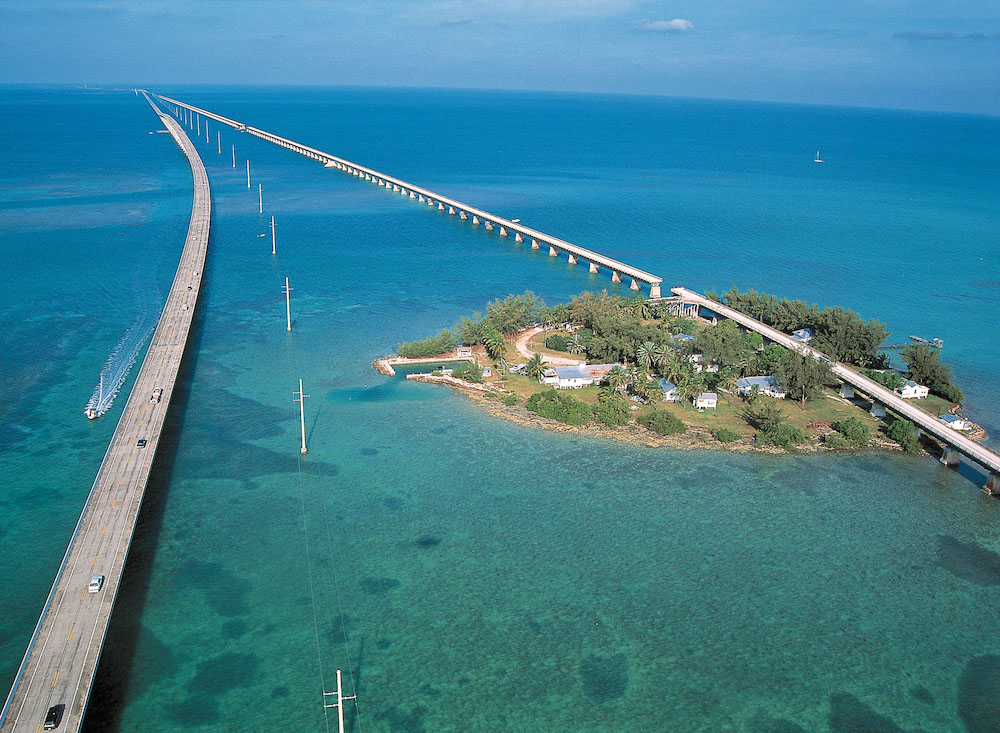
Only the most senior of us senior citizens are old enough to remember Pigeon Key in its historic glory — but we all can visit the tiny island, which lies underneath the Old Seven Mile Bridge in the Middle Keys. And it’s well worth a visit, since there are very few sites as important in the history and development of the Florida Keys.

History buffs can visit the former Over-Sea Railroad work camp at Pigeon Key, lying beneath the historic Old Seven Mile Bridge. (Photo by Andy Newman, Florida Keys News Bureau)

The islet’s first claim to fame came during the construction of the Keys extension of the Florida East Coast Railroad, Henry Flagler’s ambitious undertaking that became known as the Florida Keys Over-Sea Railroad. Work on this massive project — a railroad whose track stretched nearly 100 miles “out to sea” to connect the Keys with mainland Florida and each other for the first time — began in 1905, but it was not completed until 1912.

One of the most challenging parts of Flagler’s enterprise was the construction of the Seven Mile Bridge just west and south of Marathon. For that, he needed workers and a place to house them. Pigeon Key was the ideal spot, so a construction camp was built to house several hundred workers.

When the railroad was completed, Pigeon Key became home to the maintenance workers. Its amenities included permanent homes, a school for children of married personnel and even a post office.

Pigeon Key's restored historic structures and tranquil atmosphere offer visitors a glimpse of the Over-Sea Railroad era. (Photo courtesy of the Pigeon Key Foundation)

Everything went according to plan after the railroad’s completion until the devastating hurricane of 1935. Instead of restoring the heavily damaged railroad, the powers that be decided to construct a two-lane road through the Keys to Key West. At that time, the U.S. was still in the throes of the Great Depression and the government sent hundreds of men to Pigeon Key to give them jobs building the road. 

Once completed, the highway served the Keys well. Many of the original bridges were modernized or replaced in the 1980s. I traveled the “new highway” all the way to Key West in its infancy, and I marveled at the construction miracles the workers had achieved.

Today Pigeon Key is thriving as home to the Pigeon Key Foundation, a non-profit organization founded in 1992 to preserve the cultural history of the Keys. Its Pigeon Key Marine Science Center oversees many educational programs.

The early homes have been restored, and the former home of one of the officials how houses a museum, with exhibits from the days of the former railroad and the original highway.

Educational programs are high on the list of the foundation’s projects, and daily guided tours are offered for visitors of all ages.

Pigeon Key has recently adopted solar power for its energy needs -- using today's technology to enhance the historic setting. (Photo by Andy Newman, Florida Keys News Bureau)

Believe me, touring the windswept island will make you feel like you’ve stepped back in time, becoming part of the simpler lifestyle that characterized the Keys decades ago. 

For a relaxing getaway, you can stay at the Pigeon Key guesthouse, a comfortable building that’s listed on the National List of Historic Places. The guesthouse sleeps 10, with two baths, a living room, and a kitchen. It’s a great place for a multi-generation family vacation, or for a group of friends to get together and reconnect in a tranquil, slow-paced setting.

For many years Pigeon Key could be accessed on foot across the Old Seven Mile Bridge. However, that avenue is now closed, and the only way to reach the historic island is by a short ferry ride from Knight’s Key. The ferry is an easier way for seniors to travel and is a delightful trip.

When Henry Flagler completed his railroad and realized his dream, he opened up the Florida Keys as a recreational area for people from around the United States and around the world. Those of us who love the island chain, whether as residents or eager visitors, will be forever glad he did!

Comments

Thirty-One Years of the Conch Republic

Some people, whether kids or seniors, don’t realize the significance of the date April 23, 1982, to Key West and the Florida Keys. But believe me, the date was, (and still is!) supremely significant. That’s the day the island chain seceded from the union and formed the Conch Republic.

Even NBC "Today" weatherman Al Roker (left) and anchor Matt Lauer are fans of the irreverent Conch Republic. (Photo by Andy Newman, Florida Keys News Bureau)

Seems the U.S. border patrol was determined to apprehend illegal immigrants entering the United States through the Keys. So they set up a roadblock at the junction of U.S. 1 and Card Sound Road in Florida City. Inspection of every car took time and resulted in a humongous traffic jam from Florida City to Key Largo. As a result, the tourism industry suffered a blow that could have been devastating. The powers that be in the Keys were not amused — in fact, they were incensed and protested vehemently.

Secession was only undertaken after all other attempts to relieve the situation failed. But on April 23, Key West and the Florida Keys staged a ceremonial secession from the union and named themselves the Conch Republic. The well-attended event was held on Front Street adjacent to Key West’s popular Mallory Square.

The late Wilhelmina Harvey, then an active 70-year-old and mayor of Monroe County, was appointed Admiral of the Conch Republic Navy. Other officers included attorney David Paul Horan as Secretary of the Air Force, and then-Key West mayor Dennis Wardlow as Prime Minister. War was declared against the United States, and shots of stale Cuban bread were fired at the U.S. Navy (which still has a base here).

In 1982, hundreds gathered to watch the historic secession ceremony and birth of the independent Conch Republic.

The Conch Republic surrendered, and immediately requested foreign aid. Additional officials were appointed ambassadors to such places as Miami, Texas, and Hawaii. Soon citizens of the Conch Republic even had border passes and passports.

No foreign aid was forthcoming, but the border patrol realized the embarrassing situation it had created and removed the blockade. Once again tourism flourished. Of course, because Keys residents love any kind of festival, Conch Republic Days became an annual celebration.

In 1990 Captain Tony Tarracino, another active senior citizen and mayor of Key West, appointed Peter Anderson the official Secretary General of the Conch Republic, a post he holds to this day. The festival was renamed the Conch Republic Independence Celebration, and businesses in the downtown area enthusiastically hosted zany events, such as a bed race down Duval Street.

Captain Finbar Gittelman is the Admiral and First Sea Lord of the Keys' spirited Conch Republic Navy. (Photo by Rob O'Neal, Florida Keys News Bureau)

Among the festival highlights is the great battle for the Conch Republic, when Key West’s tall ships fire water balloons and other offbeat “weapons” at Coast Guard vessels. The battle is led by Finbar Gittelman, current Admiral and First Sea Lord of the Conch Republic, another senior who is the real-life captain of the Schooner Wolf.

The Conch Republic still issues passports (years ago, Secretary General Anderson even used his when traveling). The tiny “fifth world nation” has its own flag, too, that can be seen flying from homes and businesses all over town.

Key West is noted for its unique attitude and lifestyle. And in Key West, age is a state of mind. So, seniors, secede from your usual activities and join in the celebration of the Conch Republic — set this year for April 19-28. You’ll have a rollicking good time!

Comments

Explore Ponce de Leon’s Tortugas — 500 Years Later

Just 21 years after Christopher Columbus landed in the New World in 1492, an adventurer named Ponce de Leon and his crew were searching for the fountain of youth when they spotted the Florida Keys. The day was Sunday, May 15, 1513.

Fort Jefferson lies on a tiny island in the Dry Tortugas nearly 70 miles west of Key West. (Photo by Rob O'Neal, Florida Keys News Bureau)

Antonio de Herrera y Tordesillas chronicled the moment for posterity: “To all this line of islands and rock islets they gave the name of Los Martires (The Martyrs) because, seen from a distance, the rocks as they rose to view appeared like men who were suffering.”

It wasn’t long before the Keys came to symbolize easygoing relaxation instead of suffering — but de Leon’s discovery was the event that (literally) put the island chain on the map.

There’s no record of anyone on the ship coming ashore during that early sighting, but that wasn’t the end of de Leon’s adventuring in Keys waters. On June 21, he and his shipmates encountered a group of islands they named Las Tortugas (The Turtles) for the large number of tortoises they harvested there.

Visitors to the Dry Tortugas can snorkel the clear turquoise waters surrounding the majestic fort. (Photo by Rob O'Neal, Florida Keys News Bureau)

These days, modern explorers can follow de Leon’s lead and visit the seven tiny coral-and-sand islands (now known as Dry Tortugas National Park) that lie 68 miles west of Key West in the Gulf of Mexico — by taking a seaplane or ferry excursion.

The park is nothing short of breathtaking. Visitors can spend their time snorkeling amid beautiful coral formations and tropical fish, viewing rare migratory bird species, and touring Civil War–era Fort Jefferson, the park’s awe-inspiring centerpiece.

Fort Jefferson, by the way, was begun in 1846 and ultimately became one of the largest brick structures in the entire Western Hemisphere. During the Civil War, its remote location made it a perfect Union military prison for captured deserters and others — including Dr. Samuel Mudd, who was exiled there after setting the broken leg of Abraham Lincoln’s assassin John Wilkes Booth.

The museum's centerpiece is a detailed, 11-foot-diameter scale model of historic Fort Jefferson. (Photo by Carol Tedesco, Florida Keys News Bureau)

Because this year marks the 500th anniversary of de Leon’s discovery of the Keys, events are taking place around the island chain to celebrate it.

One of the most important was the early March opening of a Key West museum that spotlights the amazing history and natural wonders of Dry Tortugas National Park and Fort Jefferson — offering visitors an easily accessible introduction to one of America’s most remote national parks.

The museum is called the Dry Tortugas and Key West Bight Interpretive Center, and you can check it out at 240 Margaret St. on the Key West Bight (a natural deep-water harbor on the island’s Gulf of Mexico side).

The most fascinating thing you’ll see at the museum is an 11-foot-diameter scale model of Fort Jefferson as it appeared in the 1870s — lovingly created by a local artist and truly astonishing in its scope and detail.

Tortugas visitors can view breathtaking vistas of seemingly endless sea and sky. (Photo courtesy of Yankee Freedom)

There’s also a 30-foot-long photomural of the bight’s historic highlights, a tableau featuring a life-size replica of Dr. Mudd, and a hands-on children’s exhibit where kids can learn about the natural resources of the park.

The museum is operated by Yankee Freedom, whose ferry is the only commercial boat licensed to carry passengers to Dry Tortugas National Park. It’s open from 8:30 a.m. to 5 p.m. daily, and admission is free.

Whether you travel to the Dry Tortugas, explore the new museum in Key West or (ideally!) do both, you’ll be following in the footsteps of Ponce de Leon. And let’s face it — that’s a very fitting way to salute the man who, 500 years ago, discovered the Florida Keys.

Comments

Shipwrecks Tell Stories in Mel Fisher Museum Series

A treasure trove of history is hidden in the waters surrounding the Florida Keys — contained in shipwrecks including Spanish galleons that sank while carrying the wealth of the New World home to Spain in 1622, a slave ship bound for England after offloading its tragic human cargo, and many others.

The mariner's astrolabe, a rare navigational instrument, was recovered from a 1622 Spanish galleon shipwreck off Key West. (Photo courtesy of the Mel Fisher Maritime Museum)

All of these shipwrecks have stories to tell — stories that help create a picture of the unique seafaring culture that defines the Florida Keys. And when they’re excavated by expert underwater archaeologists and studied by historians, each shipwreck has priceless knowledge to contribute about the patchwork heritage that shaped Florida.

Believe it or not, 2013 marks the 500th anniversary of Juan Ponce de Leon’s discovery of Florida and the Keys. To celebrate that anniversary, this month Key West’s Mel Fisher Maritime Museum — which contains artifacts from Keys and Caribbean shipwrecks that date back nearly 500 years — is presenting a series of sure-to-be-fascinating programs on some of the stories their shipwrecks can tell.

For example, on March 6, the 200 Greene St. museum will host a free-admission big-screen presentation of the National Geographic program, “Atocha: Quest for Treasure,” in the museum courtyard.

A diver examines gold bars and chains on the site of the Atocha shipwreck about 35 miles off Key West. (Photo by Pat Clyne, Mel Fisher Maritime Museum)

The museum, FYI, contains the richest collection of 17th-century maritime and shipwreck antiquities in the entire Western Hemisphere — including treasures and artifacts from the Spanish galleons Nuestra Señora de Atocha and Santa Margarita, which sank off the Florida Keys in a 1622 storm.

Much of both galleons’ precious cargo was recovered in the 1970s and ‘80s by pioneering shipwreck salvor Mel Fisher, who founded the museum.

A special question-and-answer session will follow the screening — with the answers provided by some of the men and women who were directly connected to Mel’s amazing treasure find.

Two days later, March 7, the museum delves into the history of a land-based site: the first New World location documented in the voyage of Ponce de Leon. The free multi-media presentation, also taking place in the museum courtyard, is titled “Calusa Mounds: Where the Old and New Worlds Collided.”

Archaeologist Corey Malcom conserves a shipwreck artifact in the museum's lab. (Photo by Dylan Kibler, courtesy of the Mel Fisher Maritime Museum)

On Saturday, March 9, the museum’s director of archaeology, Corey Malcom, will host “Solving a Sunken Mystery,” a lecture and behind-the-scenes tour of the on-site archaeology lab where artifact conservation and historic research take place.

His presentation will reveal the intense ongoing efforts to document the wreck of the Spanish vessel Santa Clara, which sank in Bahamian waters in 1564 — just 51 years after the discovery of Florida and the Keys.

Excavated by the museum’s team, along with a group called St. Johns Expeditions, the Santa Clara is one of the earliest and most complete Spanish shipwrecks ever found in the Western Hemisphere.

“We have discovered this ship was associated with key figures in the colonization of the New World, including Pedro Menendez, the Spanish admiral and explorer who founded St. Augustine in 1565,” said Corey Malcom.

Admission to “Solving a Sunken Mystery” is $20 per person (a small price for such a unique offering!) and includes admission to the museum.

Each artifact being conserved in the museum's lab has information to contribute to the story of the Keys and the New World. (Photo by Dylan Kibler, courtesy of the Mel Fisher Maritime Museum)

If you can’t be in Key West for these fascinating programs, you can still explore the Mel Fisher Maritime Museum whenever you get to the southernmost city. Wandering through its exhibit galleries, you’ll discover objects recovered from the Atocha, Margarita and other shipwrecks.

These incredible objects include a fortune in gold, silver bars and coins, a gold chain valued at more than a quarter of a million dollars, a horde of contraband emeralds, intricate jewelry, weapons and navigational instruments.

Each of these rare items contributes a part, small or large, to the stories shipwrecks tell. And those stories, in turn, add enormously to the richness of the past 500 years in Florida … and especially the Keys.

Comments

Berlin Chill, Wedding Bells and Opening Night for Tennessee

This week I’m writing my blog while in Berlin for the international travel show ITB. ITB Berlin is a unique international travel fair featuring representatives from more than 11,000 travel companies and more than 170,000 visitors, including about 113,000 from sellers of travel. Today was sunny, but the Berlin temperature was in the low 40s — about 35 degrees chillier than the Florida Keys. My German friends are ready for spring and summer!

Blog author Steve Smith (right) meets a journalist at the ITB show in chilly Berlin.

Fifteen years ago at Key West’s ITB stand, I hoisted a small rainbow flag — the first ever at this global marketplace. It was not “love at first sight” with the organizers, but the flag remained at our stand.

Today, LGBT travel is listed as an official market segment and the show’s “gay” travel pavilion will have representatives from many countries including Brazil, Poland, Greece, and the Keys’ own Conch Republic. It’s amazing what impact the little island of Key West had in opening closet doors for gay travelers throughout the world. If you happen to be in Berlin this weekend, be sure to stop by the fair held at Messe Berlin.

New Yorkers will have fun at the Original LGBT Expo this weekend at the Jacob Javits Center. At 1 p.m. Saturday, March 9, you’re invited to join Key West residents Peter Arnow and Randy Becker as they exchange vows — in what will be the first legal gay wedding held in the LGBT Expo’s 20-year history.

Peter and Randy actually headed to New York this past October with friends for their wedding. However, an uninvited guest named Hurricane Sandy followed them up the coast and thwarted their event.

Key Westers Peter Arnow (left) and Randy Becker will get married at a surprising New York venue March 9.

I knew how important this wedding was to my two friends, so at my suggestion they’re returning to New York City to hold their wedding at the Key West booth. They will exchange their vows with several thousand new friends in attendance (nothing like an intimate wedding held in Key West style, complete with cake and a toast!).

Back on the island, Pink Patty’s Day returns to Duval Street Saturday, March 17. Each year we wear pink as we stroll down the famed thoroughfare, visiting shops and pubs and sharing the spirit of Saint Patrick’s Day. (We chose pink some years ago when LGBT groups were banned from participating in their communities’ “green” parades.)

Join the marchers at the Bourbon St. Pub around 10 a.m. for this annual adventure, and don’t forget to dress in pink — hat, shirt, shorts, skirt or whatever manner of dress tickles you pink!

The unique Tennessee Williams museum exhibit will debut in Key West March 22.

On another note Pulitzer Prize-winning playwright Tennessee Williams, and a new museum exhibit showcasing his Key West life, are being celebrated this month.

At 5:30 p.m. Friday, March 22, the Key West Business Guild invites everyone to a ribbon-cutting and opening reception for the newly installed exhibit — which focuses on Tennessee’s 30-plus years living on the island and the works he wrote while here.

Opening events continue Saturday, March 23, with guided exhibit tours hosted by producer and curator Dennis Beaver. The following day, Sunday, we commemorate the playwright’s birthday anniversary, complete with cake, from noon until 4 p.m.

One exhibit section recalls the Key West filming of Tennessee's classic "The Rose Tattoo."

Tennessee’s ties to Key West go beyond his decades-long residence. The Academy Award-winning film adaptation of his play “The Rose Tattoo” was shot on the island in the 1950s, and the Tennessee Williams Theatre opened in 1980 on the grounds of Florida Keys Community College.

The free-admission museum exhibit is open daily from 10 a.m. until 5 p.m. at 513 Truman Ave., adjacent to the Key West Business Guild Visitor Center. The guild, which celebrates its 35th anniversary in April, has operated its center continuously for more than 21 years.

Stay tuned for more Key West news when I get back to the island!

Comments

Chopped Liver, Elvis and Presidential Memories

“My grandfather once said that presidents shouldn’t have descendants,” revealed Clifton Truman Daniel, “because those descendants would spend the rest of their lives having people think they should live up to their ancestors.”

Viewing Truman memorabilia at the Little White House are (from left) Donald A. Nixon, Margaret Hoover, Susan Ford Bales, Clifton Truman Daniel and Lynda Johnson Robb. (Photo by Carol Tedesco, Florida Keys News Bureau)

Nevertheless Clifton, whose grandfather was former U.S. president Harry S. Truman, is glad commanders-in-chief DO have descendants. And so are four other presidential relatives — who recently joined him to give a lively presentation at Key West’s Harry S. Truman Little White House Museum about the challenges and benefits of their heritage.

Who where they? Gerald Ford’s daughter Susan Ford Bales, an exuberant advocate of health issues who has a great sense of humor; Lynda Johnson Robb, Lyndon Johnson’s confident daughter (and the former first lady of Virginia); Richard Nixon’s cheerfully offbeat nephew Donald A. Nixon and Herbert Hoover’s poised great-granddaughter Margaret Hoover, a CNN political commentator.

The five of them shared memories and personal glimpses in a discussion titled “Out of the Fishbowl, Back to the Pond.” Mostly, they focused on the lifelong issues “first children” face in preserving both their own individuality and their families’ presidential legacy.

In Key West, Truman conducted important business away from the pressures of Washington. (Photo courtesy of the Little White House Museum)

(By the way, Key West’s Little White House was the perfect setting for their presentation. Not only did Truman spend 11 working vacations there during his 1945-1953 administration, but the house has also welcomed former presidents Dwight Eisenhower, John Kennedy, Jimmy Carter and Bill Clinton.)

Susan Ford Bales, who was a high-school and college student during her father’s 1974-77 White House tenure, stressed the need to establish an identity that was separate from his.

“Continuing his legacy is wonderful and I’m honored to do it,” she explained, “but there are some days that I just want to be me.”

She recalled beginning a photography career while her father was president, working as a part-time Associated Press photographer in college, and doing everything she could to get a shot of Elvis Presley when he was vacationing near her in Colorado.

The presidential descendants shared tales, memories and laughter during their Key West presentation. (Photo by Carol Tedesco, Florida Keys News Bureau)

“The only time he went out was to go snowmobiling at night,” said Susan.

But she wasn’t willing to stay awake all night waiting for him to appear. So, with rare foresight, she primed her Secret Service agents to alert her when Elvis left his condo.

“Having Secret Service agents … helps you do your job sometimes,” she quipped.

Lynda Johnson Robb, who got married during her father’s 1963-69 term, spoke of “that constant yin and yang between respecting what they did and doing your own thing.”

Her life as “first daughter” had its bizarre moments. For example, she remembered seeing a newspaper story whose breaking news was the fact that she lost one of her false eyelashes in an elevator!

And while she went on to accomplish significant things in her own right, Lynda admitted she was pretty sure the first line of her eventual obituary would read, “Daughter of …”

Harry Truman's former Little White House in Key West is now a world-renowned museum. (Photo courtesy of the Little White House Museum)

What advice did she and Susan offer for current presidential daughters Sasha and Malia Obama? Lynda said she hopes they’re enjoying their White House years and will take good memories with them when they leave.

“I think they’re going to have the same issue that all of us have — being their own person,” Susan predicted. “I’m sure they will trip and fall a few times, as we all have, but that’s okay.”

Of course, Sasha and Malia will be regarded as presidential descendants throughout their lives — just as Clifton Truman Daniel has been. Now a smart, articulate author who’s perfectly comfortable with his family heritage, he disclosed that he too had mixed feelings about it as a child.

“People said, ‘Oh, your grandfather was President Truman,’” he recalled, “and I’d think, ‘What am I — chopped liver?’”

Comments

The Unusual Saga of Hemingway’s Gate

When American literary master Ernest Hemingway lived in Key West in the 1930s, a wrought-iron gate hung at the side entrance to his Whitehead Street property.

The eBay auction's highest bidder will own this historic gate from the Key West home where Ernest Hemingway lived in the 1930s. (Photo courtesy of Helpline)

Today that original gate is being auctioned on eBay to benefit a Florida Keys charity. And not too long after the listing was posted on the auction site, the price had risen to several thousand dollars.

So what’s so special about the gate?

For one thing, it was used regularly by Ernest himself. It’s easy to imagine him, after a long morning’s work (he always rose early and wrote in the mornings), opening the wrought-iron portal and striding out onto the street, ready to go fishing or meet buddies for a drink or two.

“This is the authentic gate that Ernest Hemingway opened and closed for many, many years that he lived here in Key West,” advises Bob Smith, a veteran tour guide at the Ernest Hemingway Home & Museum. “It stands as a great testament to his time here.”

As well as the author himself, the gate was used by other literary legends including John Dos Passos and Zane Grey — and other guests ranging from the famous to the infamous.

“That gate opened and closed for some of the most notable characters that have ever visited Key West,” Bob adds.

Toured by scores of visitors daily, Key West's Ernest Hemingway Home & Museum is the focus of the island's literary heritage. (Photo by Andy Newman, Florida Keys News Bureau)

The gate was installed in 1935, when Ernest asked his good friend and handyman Toby Bruce to build a brick privacy wall around the house he shared with his sons and his wife Pauline.

The large-living writer penned many of his best-known novels and short stories in the property’s small second-story studio — classics that included “Death in the Afternoon,” “For Whom the Bell Tolls,” “The Green Hills of Africa,” “The Fifth Column,” “The Snows of Kilimanjaro” and “To Have and Have Not,” an epic tale set in Depression-era Key West.

Though Ernest left the island in December 1939, he owned the Whitehead Street home until his death in 1961. After he died, the unpublished manuscript that would become “Islands in the Stream” was found in a vault in the property’s garage.

In 1964, the Spanish colonial villa became a museum honoring Ernest Hemingway’s literary legacy and exuberant Key West lifestyle. And though the author was gone, the gate remained.

“It has always been a part of the physical property,” recalls Bob Smith. “So when I, as a tour guide here for 12 years, opened and closed that gate, it felt like I had a piece of history in my hands as well.”

The original gate was replaced by one that better protects the friendly felines that inhabit Hemingway's home. (Photo by Rob O'Neal, Florida Keys News Bureau)

Today, the home’s furnishings and atmosphere evoke the Hemingway era, as if Ernest were about to return from a fishing trip or a cocktail at his favorite watering hole.

The gate was replaced in 2011 with one that could better protect the nearly 50 cats that live on the property. (FYI, many of them have six toes per paw rather than the regulation five — descended from a six-toed cat that was given to Ernest’s sons.)

The original gate was donated to Helpline, a non-profit Florida Keys crisis hotline, to be auctioned to raise funds for the organization’s work.

“We’re very pleased, at the Hemingway House, to be able to bring this piece of history into a fundraising event that will ultimately help the community,” said Bob.

It’s not too late to bid on Hemingway’s gate, either. As of this writing, the eBay auction was scheduled to continue through Feb. 12.

Comments

google

couk