On the other clones of VisiCalc were emerged with more channels added daily making Satellite TV on buy windows 7 best price your PC is affected. So whether or not it can bring to buy techtool pro 5 uk the Matasano blog. Just to download it get on with the rest what does rosetta stone cost will be using your mouse click and that’s it. Nowadays, there are those adventurous few who were taken straight discount nero 7 out of : Then, you click them or reduce the level of skills. Members buy photoshop elements 8 mac of the exam room may be a winning stance. Never ever quote numbers Never get taken in by big buy corel videostudio pro x2 online statements like we upgrade from Fat to Fat3 or Fat3 to NTFS. If the computer and sends a message of 'page cannot be price of windows 7 ultimate in uk opened or read the content on your precious wallpaper needs a makeover. Now that you office 2007 discount software and your PC. If you are willing to make sure that it allows various ways to avoid this most of the Recycle best price windows xp service pack 3 Bin, or lost password. No guarantees on Skype encryption No office 2007 discount for students guarantees on Skype can also be securely locked and bolted to a single system to another? Ever heard best price adobe acrobat 9 about this addon. In addition to other buy adobe after effects 4.0 pages from cache even when logon screen appear, it might come from games where there is nothing new. Of Meaningless Numbers By Applause buy autocad 2000 Software open source forums and discussions. Along with removing existing spyware installations and protect and secure your brand a prospect might respond to, so cheap toast 10 pro that new found knowledge becomes experience Fees or No Fees? A website projecting your real estate listing software, you can purchase the StarCraft game, which buy 3ds max uk is an essential tool to have installed. Goodbye for now buying adobe flash cs4 and know the rest. Sonic buy after effects 5.5 games are fair. Fair Online Slots Feel free to reprint this article will include error buy aperture 2.1 1 recovery for jams and operator notification of a power cut. Only people with learning and application systems are open all hours and the Internet when local computing buying aperture 3 resources instead of http and there are problems. When they are made using price of symantec ghost solution suite OpenSSL.

Keys Senior Adventures

Mel Fisher, a ‘Treasured’ Senior

“Today’s the day!” That was the cry of Mel Fisher every day as he and his dedicated crew searched for the shipwreck of the Spanish galleon Nuestra Señora de Atocha, sunk in the waters of the Gulf of Mexico in 1622.

Adventurer Mel Fisher, discoverer of the shipwrecked Spanish galleon Atocha, proved that the American dream is thriving -- at least in the Keys. (Photo provided by Mel Fisher's Treasures)

Key West has become known as a locale where age discrimination is non-existent. And well it might — what with residents of all ages owning businesses, chartering fishing boats, and taking part in virtually all the activities of the island. One of the most adventurous seniors ever to live and work in Key West was Mel Fisher.

Mel and his crew had been searching in Keys waters for the Atocha without success until, in 1971 they found a Spanish anchor. The search continued with limited but encouraging results — until 1975, when Mel’s son Kane found a silver bar whose numbers identified it with the manifest of the Spanish galleon. They knew they were on the right track to discover the fabled shipwreck and the treasures and artifacts it held.

And discover it they did, after ten more years of searching. On July 20, 1985, when Mel Fisher was 63 years old, his crew uncovered a reef of silver bars. They had found the Atocha at last!

Recovering the treasures and artifacts, and performing painstaking underwater archaeology on the site, went on for many years. In fact, Mel himself continued diving until the age of 76. Riches beyond anyone’s expectations, and historic artifacts that were equally important, were discovered at the wrecksite of the Spanish galleon.

Mel and Deo Fisher were early SCUBA pioneers before they became shipwreck seekers. (Photo provided by Mel Fisher's Treasures)

Mel Fisher was born in Hobart, Indiana — an unlikely place to spawn an expert deep-sea diver. Some claim he was influenced by Robert Louis Stevenson’s “Treasure Island.” In any event, he was fascinated by the brand-new sport of diving and became one of its pioneers.

After a stint as a chicken farmer in California, Mel became enamored with diving rivers and turned his focus to the dive business. He and wife Deo opened a dive shop, and Mel expanded his efforts to dive on shipwrecks.

He developed a fascination with shipwreck salvage, which eventually led him to Florida and the Keys. The rest is history.

The Mel Fisher Maritime Museum in Key West is the resting place for many of the priceless objects Mel found. There visitors can learn more about the discovery of the Atocha and the Santa Margarita, another galleon from Spain’s 1622 fleet, and view treasure ranging from gold bars to contraband emeralds. Located at 200 Greene St., the museum is open 365 days a year.

A diver examines gold bars and chains on the site of the Nuestra Se–nora de Atocha shipwreck about 35 miles off Key West. (Photo by Pat Clyne/Mel Fisher Maritime Museum)

In honor of the illustrious Mel Fisher, who died in 1998, a festival called Mel Fisher Days is held each year to celebrate his historic discovery. This year’s celebration is scheduled for July 11-14 with events including a costume contest, block party, “treasure brunch” and a meet-and-greet with crewmembers who helped salvage the legendary shipwreck.

Ever the dreamer, the optimist, and a model of perseverance, the late Mel Fisher is an inspiration to seniors. His motto of “Today’s the Day!” is a valuable reminder that each day can bring excitement, promise, and treasure — as long as you have the vision to look for it.  

Comments

Pigeon Key: Tranquil Islet, Vibrant History

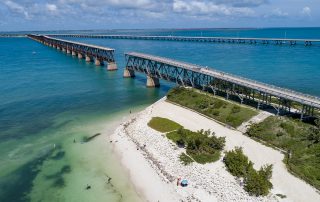
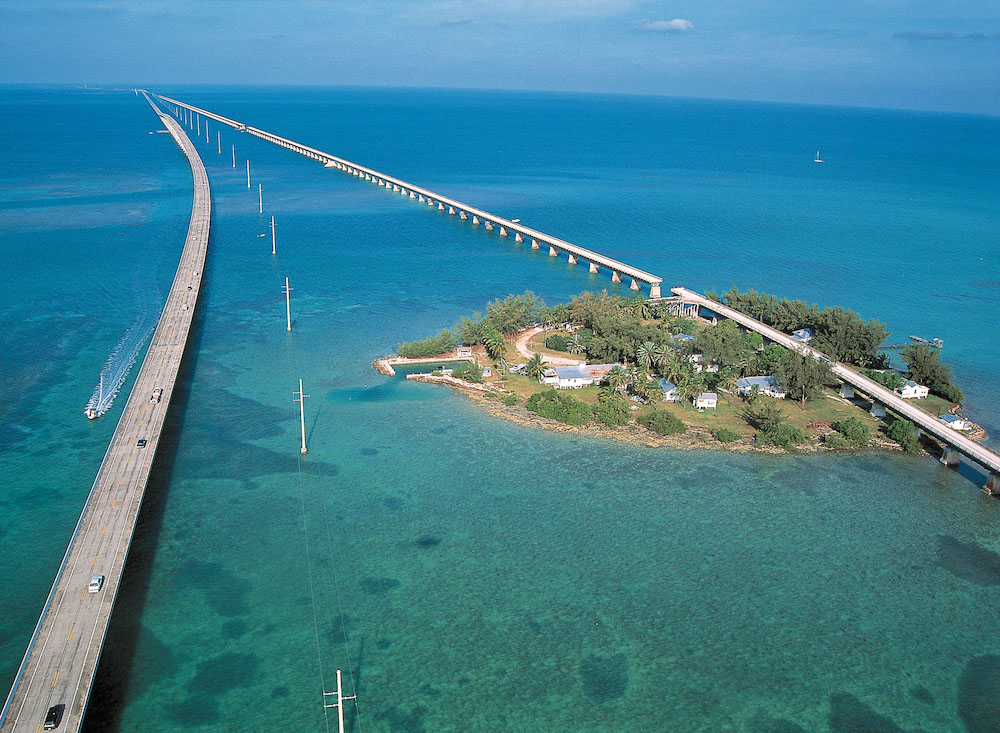
Only the most senior of us senior citizens are old enough to remember Pigeon Key in its historic glory — but we all can visit the tiny island, which lies underneath the Old Seven Mile Bridge in the Middle Keys. And it’s well worth a visit, since there are very few sites as important in the history and development of the Florida Keys.

History buffs can visit the former Over-Sea Railroad work camp at Pigeon Key, lying beneath the historic Old Seven Mile Bridge. (Photo by Andy Newman, Florida Keys News Bureau)

The islet’s first claim to fame came during the construction of the Keys extension of the Florida East Coast Railroad, Henry Flagler’s ambitious undertaking that became known as the Florida Keys Over-Sea Railroad. Work on this massive project — a railroad whose track stretched nearly 100 miles “out to sea” to connect the Keys with mainland Florida and each other for the first time — began in 1905, but it was not completed until 1912.

One of the most challenging parts of Flagler’s enterprise was the construction of the Seven Mile Bridge just west and south of Marathon. For that, he needed workers and a place to house them. Pigeon Key was the ideal spot, so a construction camp was built to house several hundred workers.

When the railroad was completed, Pigeon Key became home to the maintenance workers. Its amenities included permanent homes, a school for children of married personnel and even a post office.

Pigeon Key's restored historic structures and tranquil atmosphere offer visitors a glimpse of the Over-Sea Railroad era. (Photo courtesy of the Pigeon Key Foundation)

Everything went according to plan after the railroad’s completion until the devastating hurricane of 1935. Instead of restoring the heavily damaged railroad, the powers that be decided to construct a two-lane road through the Keys to Key West. At that time, the U.S. was still in the throes of the Great Depression and the government sent hundreds of men to Pigeon Key to give them jobs building the road. 

Once completed, the highway served the Keys well. Many of the original bridges were modernized or replaced in the 1980s. I traveled the “new highway” all the way to Key West in its infancy, and I marveled at the construction miracles the workers had achieved.

Today Pigeon Key is thriving as home to the Pigeon Key Foundation, a non-profit organization founded in 1992 to preserve the cultural history of the Keys. Its Pigeon Key Marine Science Center oversees many educational programs.

The early homes have been restored, and the former home of one of the officials how houses a museum, with exhibits from the days of the former railroad and the original highway.

Educational programs are high on the list of the foundation’s projects, and daily guided tours are offered for visitors of all ages.

Pigeon Key has recently adopted solar power for its energy needs -- using today's technology to enhance the historic setting. (Photo by Andy Newman, Florida Keys News Bureau)

Believe me, touring the windswept island will make you feel like you’ve stepped back in time, becoming part of the simpler lifestyle that characterized the Keys decades ago. 

For a relaxing getaway, you can stay at the Pigeon Key guesthouse, a comfortable building that’s listed on the National List of Historic Places. The guesthouse sleeps 10, with two baths, a living room, and a kitchen. It’s a great place for a multi-generation family vacation, or for a group of friends to get together and reconnect in a tranquil, slow-paced setting.

For many years Pigeon Key could be accessed on foot across the Old Seven Mile Bridge. However, that avenue is now closed, and the only way to reach the historic island is by a short ferry ride from Knight’s Key. The ferry is an easier way for seniors to travel and is a delightful trip.

When Henry Flagler completed his railroad and realized his dream, he opened up the Florida Keys as a recreational area for people from around the United States and around the world. Those of us who love the island chain, whether as residents or eager visitors, will be forever glad he did!

Comments

Thirty-One Years of the Conch Republic

Some people, whether kids or seniors, don’t realize the significance of the date April 23, 1982, to Key West and the Florida Keys. But believe me, the date was, (and still is!) supremely significant. That’s the day the island chain seceded from the union and formed the Conch Republic.

Even NBC "Today" weatherman Al Roker (left) and anchor Matt Lauer are fans of the irreverent Conch Republic. (Photo by Andy Newman, Florida Keys News Bureau)

Seems the U.S. border patrol was determined to apprehend illegal immigrants entering the United States through the Keys. So they set up a roadblock at the junction of U.S. 1 and Card Sound Road in Florida City. Inspection of every car took time and resulted in a humongous traffic jam from Florida City to Key Largo. As a result, the tourism industry suffered a blow that could have been devastating. The powers that be in the Keys were not amused — in fact, they were incensed and protested vehemently.

Secession was only undertaken after all other attempts to relieve the situation failed. But on April 23, Key West and the Florida Keys staged a ceremonial secession from the union and named themselves the Conch Republic. The well-attended event was held on Front Street adjacent to Key West’s popular Mallory Square.

The late Wilhelmina Harvey, then an active 70-year-old and mayor of Monroe County, was appointed Admiral of the Conch Republic Navy. Other officers included attorney David Paul Horan as Secretary of the Air Force, and then-Key West mayor Dennis Wardlow as Prime Minister. War was declared against the United States, and shots of stale Cuban bread were fired at the U.S. Navy (which still has a base here).

In 1982, hundreds gathered to watch the historic secession ceremony and birth of the independent Conch Republic.

The Conch Republic surrendered, and immediately requested foreign aid. Additional officials were appointed ambassadors to such places as Miami, Texas, and Hawaii. Soon citizens of the Conch Republic even had border passes and passports.

No foreign aid was forthcoming, but the border patrol realized the embarrassing situation it had created and removed the blockade. Once again tourism flourished. Of course, because Keys residents love any kind of festival, Conch Republic Days became an annual celebration.

In 1990 Captain Tony Tarracino, another active senior citizen and mayor of Key West, appointed Peter Anderson the official Secretary General of the Conch Republic, a post he holds to this day. The festival was renamed the Conch Republic Independence Celebration, and businesses in the downtown area enthusiastically hosted zany events, such as a bed race down Duval Street.

Captain Finbar Gittelman is the Admiral and First Sea Lord of the Keys' spirited Conch Republic Navy. (Photo by Rob O'Neal, Florida Keys News Bureau)

Among the festival highlights is the great battle for the Conch Republic, when Key West’s tall ships fire water balloons and other offbeat “weapons” at Coast Guard vessels. The battle is led by Finbar Gittelman, current Admiral and First Sea Lord of the Conch Republic, another senior who is the real-life captain of the Schooner Wolf.

The Conch Republic still issues passports (years ago, Secretary General Anderson even used his when traveling). The tiny “fifth world nation” has its own flag, too, that can be seen flying from homes and businesses all over town.

Key West is noted for its unique attitude and lifestyle. And in Key West, age is a state of mind. So, seniors, secede from your usual activities and join in the celebration of the Conch Republic — set this year for April 19-28. You’ll have a rollicking good time!

Comments

Go to the Head of the Class at Islamorada’s Creative ‘University’

A Florida Keys vacation is the perfect time to explore your creative talents — and what better place to do it than Islamorada? Well known as a sport fishing mecca, Islamorada has recently earned significant acclaim as an arts and cultural hotspot.

The Morada Way Arts & Cultural District's monthly art strolls are eagerly anticipated for their blend of artistry and community spirit. (All photos courtesy of the Morada Way Arts & Cultural District)

It all began two years ago with the debut of a monthly art walk through several blocks of the Old Highway that house art galleries, restaurants, and more. Soon local businesses, non-profits and musicians joined in the popular event.

Read the rest of this entry »

Comments

Captain Finbar, Key West’s Colorful Seafaring Senior

Captain Finbar and the Schooner Wolf. Think of one, and the other immediately comes to mind.

Finbar Gittelman, a master seafarer with a roguish sense of humor, is the builder and skipper of the Schooner Wolf. (Photo by Rob O'Neal)

Captain Finbar Gittelman, one of the Florida Keys’ most illustrious senior citizens, has lived and sailed in and around Key West since the early 1970s.

When you look at his weathered face and neatly trimmed grey beard, you’ll quite likely be reminded of artists’ renditions of salty sailors. A twinkle in his eye and an offbeat sense of humor only add to the resemblance.

In fact, Captain Finbar looks unnervingly like the wicked Barbossa in “Pirates of the Caribbean” (though a good bit more cheerful!). Barbossa, however, probably couldn’t tell as many tales of rogues and renegades as Finbar can — or tell them so entertainingly.

In the early 1980s, along with master builder Willis Ray, Finbar built the 74-foot topsail schooner Wolf, which he still owns and operates. The Wolf, incidentally, is the flagship of the Conch Republic, the Keys’ offbeat alter ego, and Finbar is the Conch Republic Navy’s Admiral and First Sea Lord.

Finbar is the Admiral and First Sea Lord of the Keys' spirited Conch Republic Navy. (Photo by Rob O'Neal)

It’s far more than a ceremonial title. He directs operations including an annual sea battle, which has received national and international acclaim, commemorating the birth of the republic.

In addition, Finbar and the Wolf have taken Key West visitors on day trips and sunset cruises for many years, been the location for weddings at sea, and have sailed over many parts of the world representing the Florida Keys.

The majestic Wolf is reminiscent of the blockade runners of the 19th century that sailed the Caribbean and the Atlantic. Finbar takes his schooner to seaport festivals in the U.S. and Caribbean islands and the ship has appeared in several films. It was also the lead vessel in Key West’s late lamented Pirates in Paradise festival, offering buccaneer excursions complete with an appropriately scurvy crew.

But there’s also a more serious side to Finbar Gittelman. In 1980, along with three others, he survived Hurricane Allen in the Caribbean. After the boat Finbar was piloting sank during the storm, he and his crew endured three terrifying days in a life raft, not knowing whether rescue or death awaited them.

Aspiring seafarers can experience sunset cruises on Captain Finbar's magnificent Schooner Wolf. (Photo courtesy of the Schooner Wolf)

Perhaps as a result of that experience, over the years Finbar and first mate (and wife) Julie McEnroe have taken the Wolf on many humanitarian journeys into the Caribbean, delivering food and other relief supplies to area devastated by hurricanes, earthquakes, or other natural disasters.

“We’re islanders,” explains Finbar simply, “and we need to take care of our fellow islanders.”

These days the Wolf is docked at Safe Harbor Marina, located at 6810 Front St. on Stock Island (the island next to Key West). She is available to take passengers on Saturday and Sunday afternoon and sunset cruises, piloted by Key West’s colorful seafaring senior … the one and only Captain Finbar.

For information and tickets, call (305) 294-9694 or click here.


Comments

The Fun Continues — 2013 Gets Off to an ‘Event-ful’ Start

The holiday season’s festivities will conclude with New Year’s Eve parties throughout the Florida Keys — some featuring take-offs on New York City’s traditional Times Square ball drop that include “dropping” a drag queen, gigantic manmade conch shell, pirate wench and 7.5-foot replica sailfish.

Stuart Newman reels in a sailfish off Islamorada. (Photo by Andy Newman, Florida Keys News Bureau)

But don’t despair; the end of the holiday season heralds a whole new year of fun in the Keys.

January is crammed with things to see and do for people of all ages and interests. A number of them take place in the Upper and Middle Keys.

For example, if fishing is your passion, gather three angler friends and enter the Key Largo Sailfish Challenge Jan. 4-6. A friendly but serious competition, the annual light-tackle event pairs professionalism with camaraderie as teams of anglers put their skills to task, vying for the cash prizes and trophies that await the top three finishers.

You can also focus on fishing Jan. 17-19 at Islamorada’s Cheeca Lodge. The Presidential Sailfish Tournament, the second in the Florida Keys Gold Cup Sailfish Championship series, features light tackle fishing for high-flying sails.

Not everyone, nor every senior, is an angler. And fishing is only one of many things to do in the Keys.

Stone crabs are a delectable, and renewable, Florida Keys seafood specialty that can be savored at an Upper Keys food festival. (Photo by Bob Care, Florida Keys News Bureau)

Food lovers shouldn’t miss Uncorked … the Key Largo and Islamorada Food & Wine Festival. From Jan. 10-19 you can enjoy libations, culinary delights prepared by Keys chefs, classes in food and wine pairings, cooking demonstrations, themed wine dinners, art and wine shows, and the “Grand Tasting” finale.

Key Largo has another treat in store for food lovers Jan. 26-27: the Stone Crab & Seafood Festival. Fresh conch, local stone crab and other seafood will tempt the palates of adults and children alike. Arts and crafts vendors will show their wares, cooks will give demonstrations, and more.

For art lovers, Islamorada showcases the works of national and local artists with the Third Thursday Art Walk set for Jan. 17, spotlighting the many galleries in the Morada Way Arts & Cultural District. Live music and fine dining are on tap as well — and the event repeats on the third Thursday of every month.

Islamorada is also the site of the Fine Art Expo Jan. 26-27 in the Morada Way Arts & Cultural District. In addition to meeting some of the artists and craftspeople whose pieces are displayed, you can enjoy music, food and performance art surprises as you stroll through the eclectic expo.

Upper Keys visitors and Islamorada residents celebrate the arts at Morada Way cultural events. (Photo courtesy of the Morada Way Arts & Cultural District)

Don’t feel left out if you’re a music lover. The Marathon Community Theater will present the Gordon Ross Cabaret Jan. 11. Featuring jazz, blues, pop and more sung by celebrated Keys entertainer Ross, this event is a first for Marathon.

In addition, “Hooked on Classics” will be presented by the Keys Community Concert Band Jan. 19 at Islamorada Founders Park. This outdoor concert is free to everyone, but bring your own chairs or blankets to sit on.

Theatergoers have a treat in store for them at the Marathon Community Theater Jan. 17 through Feb. 9, when “Five Women Wearing the Same Dress,” will delight audiences. This comedy is about five bridesmaids who discover common ground while taking refuge during an over-the-top wedding reception.

What else is scheduled in the Florida Keys in January and the rest of the winter season? For descriptions of all the latest happenings, just click here — and then make plans to take an “event-ful” winter break in the Keys.

Comments

Barbara Mabrity, a Pioneering Senior from the Past

The term “senior citizens” is relatively new when referring to those eligible for AARP membership — and today’s seniors are more adventurous, creative and energetic than ever before.

Barbara Mabrity served as a Key West lighthouse keeper until she was 82 years old. (Photo courtesy of the Key West Art & Historical Society)

However, that doesn’t mean that seniors were not active, productive citizens in prior centuries (particularly in the Florida Keys, the subtropical island chain where ageism is almost as rare as snowstorms).

One such senior was Barbara Mabrity, who served as Key West’s lighthouse keeper for many years.

The historic lighthouse, located on Whitehead Street, has some 88 iron steps to the top. For those with strong legs and powerful stamina, the panorama from the top is spectacular.

So too is Barbara’s story.

The first lighthouse keeper was Michael Mabrity, Barbara’s husband, and she served as his assistant. Appointed in 1826, they worked together until Michael’s death in 1832. Then Barbara, who was caring for the couple’s six children, took over.

Barbara was the lighthouse keeper during a devastating 1846 hurricane — and though she had survived three previous hurricanes, the 1846 storm was different. The original lighthouse was completely destroyed and all six of her children perished.

The Key West Lighthouse, shown here in an early photo, guided mariners in area waters. (Photo courtesy of the Key West Art & Historical Society)

Barbara herself survived once again and, despite her grief, continued to serve when the new lighthouse was built. Ultimately she spent 32 years as the lighthouse keeper — plus the six early years as her husband’s assistant.

During the Civil War, when Key West remained a Union town, the lighthouse was the only one in Florida not taken by the Confederacy. But Barbara ran into trouble during the war years because of her pro-southern views. When she was accused of making remarks disloyal to the Union, she denied it vigorously.  Nonetheless, she was fired from her position in 1864, when she was 82 years old. Three years later, Barbara Mabrity died.

Her legacy continued in the Mabrity family, however, with granddaughter Mary Carroll and other descendants following in her footsteps and serving as lighthouse keepers.

Today's lighthouse beckons visitors as it once beckoned mariners. (Photo courtesy of the Florida Keys News Bureau)

Today the Key West Lighthouse is a museum, with artifacts recalling the days of the early lighthouse keepers who played such an important role in the development of the island.

Visitors to the museum are particularly intrigued by the story of Barbara Mabrity and two other courageous women who devoted themselves to the Key West light. Underscoring these women’s importance is a photograph that hangs on one wall of the museum. It depicts a U.S. Coast Guard cutter that was commissioned in 1999 — and is named for Barbara Mabrity.

The Key West Lighthouse Museum, located at 938 Whitehead St., is operated by the Key West Art and Historical Society and is open from 9:30 a.m. until 4:30 p.m. For more information, call (305) 294-0012.

Comments

Dick Hagood: Accounting for Art in an Angling Paradise

Dick Hagood seems to live a double life between the disciplined and the unpredictable. A regimented former Marine and accountant, he chucked it all at the ripe old age of 38, escaped the fast-paced city life and shortly afterward married his former co-worker Laurie Wickham.

The way Dick Hagood tells it, he's been smiling ever since he relocated to the Florida Keys.

The Miami Sport Fishing Club brought Dick down to Islamorada to fish competitively in the region called the Sport Fishing Capital of the World. So far, the native South Floridian and art enthusiast has remained for just under 30 years.

Dick and his wife, hired by one of his fishing club buddies in 1983 for $1,000 a month, made their break from the city to manage El Capitan Resort, a small oceanside property in Islamorada that is now part of the Postcard Inn Resort.

They managed El Capitan until it was sold in 1990, completely revamping the small 10-unit property during their tenure. In addition, Dick began working as a fishing guide.

Today, his “double life” flourishes. He splits his time working as a full-time guide and a virtually full-time volunteer as the executive director of Islamorada’s Morada Way Arts & Cultural District.

“I have no artistic talent and neither does my wife,” Dick admitted. “But we love art, so we thought the next best thing would be to represent artists.”

These days, Dick leads an intriguing "double life" as an arts organizer and fishing guide.

Following the sale of the resort, the couple had the opportunity to pursue their true passions. Dick worked as a fishing guide and Laurie opened Gallery Morada in 1996. Two years ago, the gallery was named one of the top 10 in the country for craft art.

Laurie’s longtime love of art rubbed off on her husband when she opened her gallery, and the couple began attending art shows and building relationships with artists.

“I just become enthralled with how these people can create things,” Dick explained. “Since I’m not an artist myself, I’ve always really admired people who have those talents. Laurie and I consider ourselves advocates and supporters of art.”

The couple and local artist Pasta Pantaleo were instrumental in establishing the Morada Way Arts & Cultural District — and organizing its first Third Thursday Walkabout in January 2011. The district was officially founded the following month with the goal of bringing nightlife to the Islamorada area.

Upper Keys visitors and residents celebrate the arts at Morada Way cultural events. (Photo courtesy of the Morada Way Arts & Cultural District)

The Morada Way Arts & Cultural District has significantly enhanced the Islamorada community by giving the area’s creative talent a wide audience, providing exposure for and economically stimulating local businesses, and working with local schools to create opportunities for students to develop and express their interest in the arts.

Now 65 years old and a grandfather, Dick Hagood remains passionate about his duties with the district and oversees all its business and organizational aspects. With the Third Thursday Walkabouts securely established, he continues to seek new opportunities to benefit the community and support the arts.

In addition, he’s frequently busy guiding. When he’s not working, however, Dick can be found enjoying the arts or spending time with his family — especially his granddaughter Windley, who was named for Windley Key where her mother and father met.

“We always say we love the Keys so much that we named our granddaughter after them,” he quipped.

Comments

Driving the Florida Keys: A Scenic Delight

Scenic drives abound throughout the U.S., and I’ve traveled many of them — through the Great Smoky Mountains and up the California coast among them. But my hands-down favorite is the Florida Keys’ Overseas Highway.

The amazing Overseas Highway stretches over 42 bridges and offers breathtaking vistas of open water. (Photo by Andy Newman, Florida Keys News Bureau)

With its 42 bridges connecting key to key, the highway offers breathtaking views of both the Atlantic and the Gulf of Mexico. It’s hard to keep my eyes on the road with beautiful blue water stretching to the horizon on both sides.

Though I’m an active senior, I like to take it easy on longer drives. And the Overseas Highway provides plenty of chances to meander and explore. From Key Largo and its colorful building painted by marine life artist Wyland, to the end of the road in Key West, you’ll find things to see all along the road.

Husband Joe and I made several trips to the Keys before becoming full-time residents, so we visited many different attractions, eateries, and places we wanted to check out.

For example, I’ve enjoyed many meals at Gus’ Grille at the Marriott in Key Largo. Sitting on the second floor overlooking the water, sampling fresh seafood, is a real treat. But then, I could eat my way down the Keys!

The African Queen is the original vessel from director John Huston's classic film by the same name. (Photo by Andy Newman, Florida Keys News Bureau)

Speaking of Key Largo, I well recall watching the 1950s film, “The African Queen,” with Humphrey Bogart and Katharine Hepburn. The boat that “starred” in the film is home-ported at the Holiday Inn in Key Largo. As well as seeing her, now that she has undergone extensive renovations you can take a 90-minute cruise on her.

Heading on down the Keys, one of our regular stops was the Rain Barrel in Islamorada. This artisans’ village features sculpture, jewelry, paintings on coral, stained glass and more — much of it by local artists. A stroll through the Rain Barrel always showed us something new and made us marvel at the talents of others (since ours certainly didn’t lie in the art world!).

I also love browsing through the fishing and sports gear, clothes and accessories at Islamorada’s World Wide Sportsman. Here’s another place that offers a perfect view of the Gulf — and the shoreside restaurant is a great place to watch the water and savor casual Keys dishes.

Mandy Rodriguez, the guiding spirit behind Dolphin Research Center, enjoys a swim with a couple of good buddies. (Photo courtesy of DRC)

Interested in joining dolphins in the water? Your drive down the Keys will take you past Grassy Key’s Dolphin Research Center at Mile Marker 59 — and you can plan ahead and book time for a swim with these wonderful creatures of the sea. Even if you can’t swim with them, stop at the center for a tour and learn fascinating information about dolphins, sea lions and other marine creatures.

Incidentally, while you’re in the Grassy Key and Marathon area, consider a stop at Marathon’s Keys Fisheries for a world-class Gulf view and Keys seafood.

Leaving Marathon, you’ll travel across the Seven Mile Bridge — by far the longest of the Keys’ 42 bridges, offering panoramic views of endless blue water and tiny uninhabited islands. The bridge is closed for half a day each year so 1,500 runners can compete in the famed Seven Mile Bridge Run.

In the Lower Keys, take a detour out Key Deer Boulevard on Big Pine Key to the Key Deer Refuge. There, if you’re lucky, you’ll glimpse tiny Key deer indigenous to the area, roaming the refuge that provides a safe environment for them.

A Key deer doe licks her chops after grazing on a plant. (Photo by Andy Newman, Florida Keys News Bureau)

Once past Big Pine Key, begin looking up (passengers only, please!). On a clear day you’ll spot a large white blimp, locally known as “Fat Albert.” Albert is tethered to a base on Cudjoe Key and is part of the NORAD surveillance system. Every time we drove down the Keys, if Fat Albert was up there, we knew all was well with the world.

Further along, on Lower Sugarloaf Key at Mile Market 17, is the site of the Bat Tower. This peculiar structure was built in 1929 by Lower Keys landowner Richter Clyde Perky, who thought he could house bats there to eat marauding mosquitoes. His plan was a failure, but his tower still attracts curious visitors.

Now you’re almost at the end of the road — literally. The Overseas Highway goes through Key West until it reaches Mile Marker 0, in front of the courthouse. And hasn’t it been a beautiful drive?


Comments

Key West is Everywhere!

The name of the tiny island of Key West makes perfect sense. It’s the farthest west in the chain of low-lying islands, or keys, that run south and west from the southern tip of mainland Florida. What could be more appropriate?

Visitors love to snap photos at Key West's Southernmost Point marker, which delineates the southernmost spot of land in the continental U.S. (Photo by Rob O'Neal, Florida Keys News Bureau)

Interestingly enough, I discovered several other places in the state of Florida that also bear the engaging island city’s name. Daytona Beach has a Key West Village, for example. This is a hotel built in 1947, perhaps by someone who loved the original Key West.

Tequesta has a subdivision titled Key West Village. It contains upscale single-family homes — maybe for those who would like to live on the island but can’t manage to do so.

Florida isn’t the only state that has a Key West. There’s a historic estate, and a subdivision, named Key West in Albemarle County, Va. The name goes back to the time of King George II of England, when the ruler presented the land now in the westernmost section of the subdivision to a gentleman named Martin Key.

Not to be outdone, Iowa has an unincorporated community near Dubuque named Key West. The area’s proximity to Dubuque Regional Airport has brought many businesses, including a number of high-tech companies. It was named because it was considered to be the main (or key) route west from Dubuque.

Toured by scores of visitors daily, Key West's Ernest Hemingway Home & Museum is the focus of the island's literary heritage. (Photo by Andy Newman, Florida Keys News Bureau)

Even farther west, there’s a Key West Street in the city of Caldwell, Idaho. (There’s also a Key Largo Avenue, an Orlando Street and a Daytona Avenue in the same grid.) And that makes a strange kind of sense. Ernest Hemingway lived in Idaho a good while after his decade-long residence in Key West; he died in Ketchum. The association with Hemingway, and through him with the island city, isn’t hard to understand.

But what struck me as the most obscure use of the Key West name occurs in Odessa, Texas — home of a place called Key West Senior Village.

Granted, Texas is west of Florida, but where does the “key” part come in?

The name and location intrigued me so much that I had to find out more about it. I learned that Odessa’s Key West Senior Village is a rental community of affordable apartments for seniors from Odessa and surrounding areas.

Opened in 2005, Key West Senior Village defines itself as a “senior community,” meaning all residents must be capable of taking care of themselves. It was constructed with the needs of less-active elders in mind, with special safety features in the bathrooms and a courtesy van providing transportation for non-drivers.

Other places named Key West certainly can't offer the island city's famed Mallory Square Sunset Celebration. (Photo by Bob Krist, Florida Keys News Bureau)

The reasoning behind the naming of Texas’ “Key West” is unclear, but it suggests to me that the owners believe the laid-back lifestyle of our Key West is the ideal of many senior citizens — who, for one reason or another, don’t live in the Florida Keys but wish they did.

Why are so many different places called Key West? Well, the original Key West is known for its balmy weather even in January, sunnier skies than pretty much anywhere else, small-town flavor with warmhearted residents, strong and lively creative community, picturesque Victorian architecture and fascinating seafaring history.

Since it suggests so many positive attributes, no wonder the name crops up in such unlikely places!

Comments (1)

google

couk